Blackstone Minerals (BSX:AU) has announced Blackstone Secures New Diamond Drill Rig to Advance Mankayan
Download the PDF here.
This post appeared first on investingnews.com

Blackstone Minerals (BSX:AU) has announced Blackstone Secures New Diamond Drill Rig to Advance Mankayan
Download the PDF here.
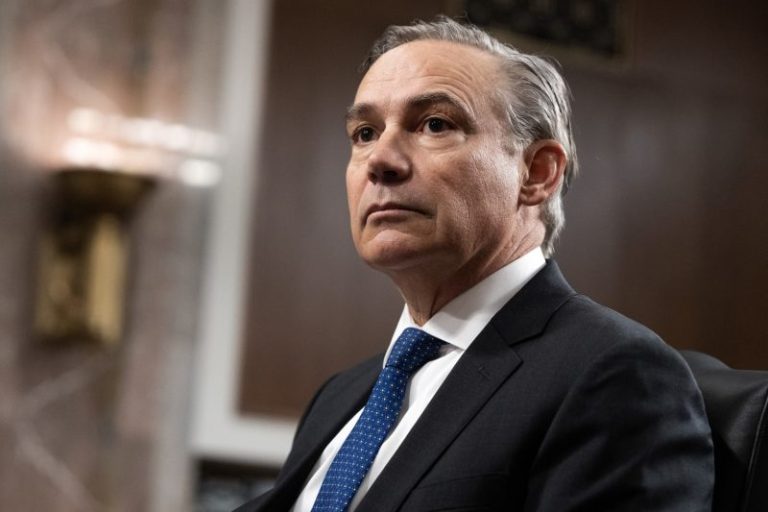
After spiraling from crisis to crisis over much of the past seven years, Boeing is stabilizing under CEO Kelly Ortberg’s leadership.
Ortberg, a longtime aerospace executive and an engineer whom the manufacturer plucked from retirement to fix the problem-addled company last year, is set this week to outline significant progress since he took the helm a year ago. Boeing reports quarterly results and gives its outlook on Tuesday.
So far, investors are liking what they’ve been seeing. Shares of the company are up more than 30% so far this year.
Wall Street analysts expect the aircraft manufacturer to halve its second-quarter losses from a year ago when it reports. Ortberg told investors in May that the manufacturer expects to generate cash in the second half of the year. Boeing’s aircraft production has increased, and its airplane deliveries just hit the highest level in 18 months.
It’s a shift for Boeing, whose successive leaders missed targets on aircraft delivery schedules, certifications, financial goals and culture changes that frustrated investors and customers alike, while rival Airbus pulled ahead.
“The general agreement is that the culture is changing after decades of self-inflicted knife wounds,” said Richard Aboulafia, managing director at AeroDynamic Advisory, an aerospace consulting firm.
Analysts expect the company to post its first annual profit since 2018 next year.
“When he got the job, I was not anywhere as near as optimistic as today,” said Douglas Harned, senior aerospace and defense analyst at Bernstein.
Ortberg’s work was already cut out for him, but the challenges multiplied when he arrived.
As the company hemorrhaged cash, Ortberg announced massive cost cuts, including laying off 10% of the company. Its machinists who make the majority of its airplanes went on strike for seven weeks until the company and the workers’ union signed a new labor deal. Ortberg also oversaw a more than $20 billion capital raise last fall, replaced the head of the defense unit and sold off its Jeppesen navigation business.
Ortberg bought a house in the Seattle area, where Boeing makes most of its planes, shortly after taking the job last August, and his presence has been positive, aerospace analysts have said.
“He’s showing up,” Aboulafia said. “You show up, you talk to people.”
Boeing declined to make Ortberg available for an interview.
Boeing’s leaders hoped for a turnaround year in 2024. But five days in, a door-plug blew out of a nearly new Boeing 737 Max 9 as it climbed out of Portland. The almost-catastrophe brought Boeing a production slowdown, renewed Federal Aviation Administration scrutiny and billions in cash burn.
Key bolts were left off the plane before it was delivered to Alaska Airlines. It was the latest in a series of quality problems at Boeing, where other defects have required time-consuming reworking.
Boeing had already been reeling from two deadly Max crashes in 2018 and 2019 that sullied the reputation of America’s largest exporter. The company in May reached an agreement with the Justice Department to avoid prosecution stemming from a battle over a previous criminal conspiracy charge tied to the crashes. Victims’ family members slammed the deal when it was announced.
For years, executives at top Boeing airline customers complained publicly about the manufacturer and its leadership as they grappled with delays. Ryanair CEO Michael O’Leary told investors in May 2022 that management needed a “reboot or boot up the arse.”
Last week, O’Leary had a different tune.
“I continue to believe Kelly Ortberg, [and Boeing Commercial Airplane unit CEO] Stephanie Pope are doing a great job,” he said on an earnings call. “I mean, there is no doubt that the quality of what is being produced, the hulls in Wichita and the aircraft in Seattle has dramatically improved.”
United Airlines CEO Scott Kirby cast doubt over the Boeing 737 Max 10 after the January 2024 door-plug accident, as the carrier prepared not to have that aircraft in its fleet plan. The plane is still not certified, but Kirby has said Boeing has been more predictability on airplane deliveries.
Still, delays for the Max 10, the largest of the Max family, and the yet-to-be certified Max 7, the smallest, are a headache for customers, especially since having too few or too many seats on a flight can determine profitability for airlines.
“They’re working the right problems. The consistency of deliveries is much better,” Southwest Airlines CEO Bob Jordan said in an interview last month. “But there’s no update on the Max 7. We’re assuming we are not flying it in 2026.”
Boeing under Ortberg still has much to fix.
The FAA capped Boeing’s production at 38 Maxes a month, a rate that it has reached. To go beyond that, to a target of 42, Boeing will need the FAA’s blessing.
Ortberg said this year that the company is stabilizing to go beyond that rate. Manufacturers get paid when aircraft are delivered, so higher production is key.
“I would suspect they would be having those discussions very soon,” Harned said. “It’s 47 [a month] that I think is the challenging break.”
He added that Boeing has a lot of inventory on hand to help increase production.
Its defense unit has also suffered. The defense unit encompasses programs like the KC-46 tanker program and Air Force One, which has drawn public ire from President Donald Trump. Trump, frustrated with delays on the two new jets meant to serve the president, turned to a used Qatari Boeing 747 to potentially use as a presidential aircraft, though insiders say that used plane could require months of reoutfitting.
Ortberg replaced the head of that unit last fall.
A strike could also be on the horizon at the defense unit after factory workers “overwhelmingly” rejected a new labor deal, according to their union, the International Association of Machinists and Aerospace Workers Local 837.
“The proposal from Boeing Defense fell short of addressing the priorities and sacrifices of the skilled IAM Union workforce,” the union said Sunday. “Our members are standing together to demand a contract that respects their work and ensures a secure future.”
There is a seven-day cooling off period before a strike would begin, if a new deal isn’t reached.
“They’re not totally out of the woods,” Harned said.
Boeing and Ortberg also need to start thinking about a new jet, some industry members said. Its best-selling 737 first debuted in 1967, and the company was looking at a midsize jetliner before the two crashes sent its attention elsewhere.
“Already there’s been a reversal from ‘read my lips, no new jet.’ I would like to see that accelerate,” Aboulafia said. “He is the guy to make that happen.”
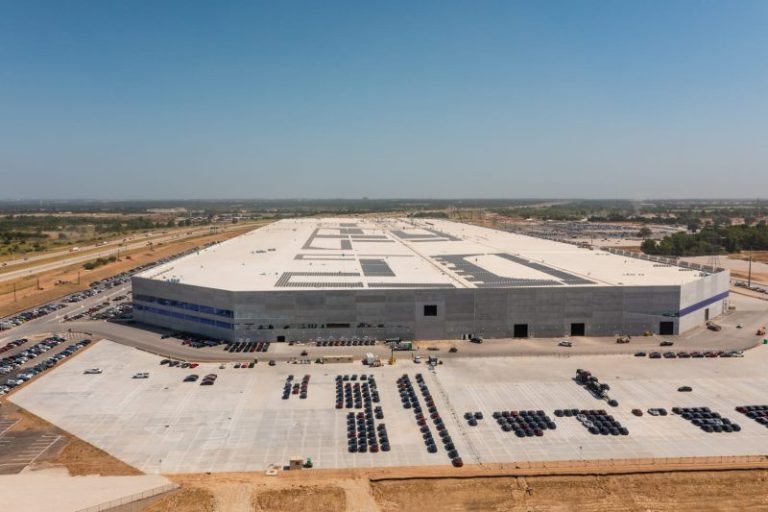
Samsung Electronics has entered into a $16.5 billion contract for supplying semiconductors to Tesla, based on a regulatory filing by the South Korean firm and Tesla CEO Elon Musk’s posts on X.
The memory chipmaker, which had not named the counterparty, mentioned in its filing that the effective start date of the contract was July 26, 2025 — receipt of orders — and its end date was Dec. 31, 2033.
However, Musk later confirmed in a reply to a post on social media platform X that Tesla was the counterparty.
He also posted: “Samsung’s giant new Texas fab will be dedicated to making Tesla’s next-generation AI6 chip. The strategic importance of this is hard to overstate. Samsung currently makes AI4.TSMC will make AI5, which just finished design, initially in Taiwan and then Arizona.”
“Samsung agreed to allow Tesla to assist in maximizing manufacturing efficiency. This is a critical point, as I will walk the line personally to accelerate the pace of progress,” Musk said on X, and suggested that the deal with Samsung could likely be even larger than the announced $16.5 billion.
Samsung earlier said that details of the deal, including the name of the counterparty, will not be disclosed until the end of 2033, citing a request from the second party “to protect trade secrets,” according to a Google translation of the filing in Korean on Monday.
“Since the main contents of the contract have not been disclosed due to the need to maintain business confidentiality, investors are advised to invest carefully considering the possibility of changes or termination of the contract,” the company said.
The company’s shares rose over 6% in trading on Monday to reach their highest level since September 2024.
Tesla was a probable customer, Ray Wang, research director of semiconductors, supply chain and emerging technology at The Futurum Group, told CNBC before Musk’s post. Bloomberg News had earlier reported that Samsung’s deal was with Tesla, citing a source.
Samsung’s foundry service manufactures chips based on designs provided by other companies. It is the second largest provider of foundry services globally, behind Taiwan Semiconductor Manufacturing Company.
The company stated in April that it aimed to commence 2 nanometer mass production in its foundry business and secure major orders for the next-generation technology. In semiconductor technology, smaller nanometer sizes signify more compact transistor designs, which lead to greater processing power and efficiency.
Local South Korean media outlets have also reported that American chip firm Qualcomm could place an order for chips manufactured using Samsung’s 2 nanometer technology.
Samsung, which is set to deliver earnings on Thursday, expects its second-quarter profit to more than halve. An analyst previously told CNBC that the disappointing forecast was due to weak orders for its foundry business and as the company has struggled to capture AI demand for its memory business.
The company has fallen behind competitors SK Hynix and Micron in high-bandwidth memory chips — an advanced type of memory used in AI chipsets.
SK Hynix, the leader in HBM, has become the main supplier of these chips to American AI behemoth Nvidia. While Samsung has reportedly been working to get the latest version of its HBM chips certified by Nvidia, a report from a local outlet suggests these plans have been pushed back to at least September.

The copper price climbed to a record high of US$5.64 per pound on the COMEX during the second quarter of 2025.
The price rise comes on the back of escalating trade tensions and economic chaos from the United States’ new tariff policy.
While copper was initially spared from tariffs at the start of the year, US President Donald Trump announced the US would be imposing a 50 percent tariff on all copper products entering the US. The announcement sparked speculative buying by US metals traders, who sought to position themselves ahead of the yet-to-be-announced tariff deadline.
How has this affected small-cap copper-focused companies on the TSX Venture Exchange? Read on to learn about the five best-performing junior copper stocks since the start of 2025.
Data for this article was gathered on July 17, 2025, using TradingView’s stock screener, and copper companies with market caps of over C$10 million at that time were considered.
Year-to-date gain: 655.56 percent
Market cap: C$13.5 million
Share price: C$0.34
Camino Minerals is a copper exploration and development company with a portfolio of projects in South America.
Among its primary focuses since the start of the year is the construction-ready Puquois copper project in Chile, a 50/50 joint venture with Nittetsu Mining (TSE:1515). The partners jointly acquired Cuprum Resources, the project’s owner, through a October 2024 definitive agreement that was completed on April 17, and are now focused on project financing.
Prior to the closing of the acquisition, the partners completed a prefeasibility study for the project in Chile on March 17.
The study results demonstrate a post-tax net present value of US$118 million, with an internal rate of return of 23.4 percent and a payback period of 3.1 years at a fixed copper price of US$4.28. It also outlines all-in sustaining costs of US$2.00 per pound for the 14.2 year mine life.
In addition to the economic details, the included mineral resource estimate shows a measured and indicated resource of 149,000 metric tons of copper from 32.16 million metric tons of ore grading 0.46 percent copper.
Camino also owns the Los Chapitos project, located near the coastal town of Chala, Peru, which covers approximately 22,000 hectares and hosts near-surface mineralization. Nittetsu Mining has an earn-in agreement for the project through which it can earn a 35 percent interest in the project for a total investment of C$10 million over three years.
Camino announced on January 22 that it had initiated a discovery exploration program at Los Chapitos, with work funded by Nittetsu. The company said the program would consist of 11 holes and 1,200 meters of drilling along the La Estancia fault, focusing on newly identified copper breccias and mantos to determine their extension at depth.
Camino released results from the program on May 6, reporting continuity of mineralization at depth at the Pampero prospect, with a 0.5 meter interval found 157.6 meters downhole grading an average of 0.5 percent copper and 3.15 grams per metric ton (g/t) silver. The company also reported that rock chip samples at the prospect graded up to 3.8 percent copper and 4 g/t silver.
The company has continued its exploration efforts at Los Chapitos, with another fully funded campaign running from June 1 to November 30. On July 16, it reported trench results from the newly identified Mirador zone, including 1.07 percent copper over 90 meters, with a 4 meter section grading 3.05 percent copper.
Shares of Camino reached a year-to-date high of C$0.34 on July 16.
Year-to-date gain: 425 percent
Market cap: C$15.84 million
Share price: C$0.105
Finlay Minerals is an exploration company with a portfolio of five projects in British Columbia, Canada.
In 2025, the company has largely focused on its ATTY and PIL projects, which cover 3,875 hectares and 13,374 hectares respectively in BC’s Toodoggone mining district. The region is known for copper-molybdenum-gold porphyry deposits and gold-silver epithermal deposits.
Finlay’s shares rose sharply early in the year after Amarc Resources announced the significant AuRORA discovery at its JOY property, located just south of the PIL project in the same porphyry corridor as PIL and ATTY. On January 20, shortly after the discovery, Finlay announced it would be renewing its focus on its PIL project’s PIL South target, which lies approximately 750 meters from AuRORA.
One month later, Finlay reported it had outlined numerous copper targets at both the PIL and ATTY properties after reviewing geological data, and was planning its 2025 exploration program at PIL to delineate drill targets.
Shares surged in Q2 after Finlay announced on April 17 that it had entered into an earn-in agreement with Freeport McMoRan for PIL and ATTY. Under the terms of the agreement, Freeport can earn an 80 percent stake in the properties through a total of C$35 million in exploration expenditures and C$4.1 million in cash payments over the next six years.
In an update on June 18, Finlay reported that it had begun its exploration programs at both properties, fully funded by Freeport. At both properties, exploration will include property-wide airborne magnetic surveys, and induced polarization geophysical surveys. It will also include detailed geological and alteration mapping, along with rock and soil sampling, on up to eight targets at PIL and three targets at ATTY.
The most recent news came on July 17, when Finlay announced it had increased the exploration program budget for PIL to C$2.6 million from C$750,000 and the budget for ATTY to C$1 million from C$500,000. The company stated that the additional funding will be utilized to identify and prioritize as many targets as possible for drilling in 2026.
Year-to-date gain: 420 percent
Market cap: C$52.92 million
Share price: C$0.26
King Copper Discovery is a copper, silver and gold explorer that is developing a portfolio of projects in South America. The company changed its name from Turmalina Metals in March.
Its primary focus is the Colquemayo project in Moquegua, Peru. In July 2024, King Copper entered into an option agreement with Compania de Minas Buenaventura (NYSE:BVM) to wholly acquire the property.
The company has been relogging the historic drill core from the site. The 6,600 hectare site has seen more than 20,000 meters of historic core drilling and hosts multiple porphyry targets that have been identified but had gone untested. Highlighted drill samples show results of 2.4 percent copper and 10 grams per metric ton (g/t) silver over 237.3 meters, including 14.8 percent copper and 47 g/t silver over 31.3 meters.
In a broad corporate update on February 12, the company said it was intensifying its focus on the project and rebranding from Turmalina to reflect that. Additionally, it hired Insideo, a Lima-based environmental consulting firm, to help advance baseline studies and the drill permit process. Additionally, CEO Roger James stepped down, maintaining a seat on the board, and was replaced by Jonathan Richards as interim CEO.
On March 11, the company began trading under its new name and ticker.
The company has not provided any updates from its projects in the second quarter of the year, but shares have traded higher alongside a rising copper price. On July 15, it released an updated corporate presentation with plans for a 15,000 meter drill program in Q4 testing porphyry systems at the site with holes over 1,000 meters deep.
Shares of King Copper reached a year-to-date high of C$0.26 on July 16.
Year-to-date gain: 251.22 percent
Market cap: C$166 million
Share price: C$0.72
Amarc Resources is a copper exploration company primarily focused on advancing its JOY district in Northern British Columbia.
The 495 square kilometer property lies within the Toodoggone region and hosts the AuRORA prospect.
Shares in Amarc surged early in the year after it announced the discovery of AuRORA on January 17. In the release, it outlined the high-grade potential of the deposit, highlighting an assay of 0.63 percent copper over 162 meters, including an 81 meter intersection grading 0.92 percent copper, from near surface depths.
The exploration program was funded as part of a May 2021 earn-in agreement with Freeport McMoran that could see Freeport earn a 70 percent stake in the project once funding milestones are met.
Amarc provided more drill assays from its 2024 program on February 28. One assay graded 0.63 percent copper over 132 meters, including 0.81 percent over a 90 meter segment.
On February 11, Amarc agreed to acquire the Brenda property, which lies directly to the east of the AuRORA discovery, from Canasil Resources. Under the terms of the deal, Amarc has the option to acquire a 100 percent interest in Brenda over five years. Canasil will retain a 2 percent net smelter return.
The most recent news from JOY came on July 16, when the company announced it commenced drilling at targets including the AuRORA and PINE deposits and the Twins and Canyon discoveries. The announcement also reported the expansion of the JOY district through Freeport’s options on Finlay’s PIL property.
In addition to exploration at JOY, Amarc also released assay results from its 2024 exploration at its IKE copper-gold project in Southern British Columbia on May 14. The company reported copper grades of 0.29 percent copper over 181 meters, including an intersection with 0.56 percent copper over 60 meters.
Shares in Armac reached a year-to-date high of C$0.77 on July 4.
Year-to-date gain: 233.33 percent
Market cap: C$74.91 million
Share price: C$0.80
C3 Metals is an exploration company working to advance its assets in Jamaica and Peru.
C3’s primary Jamaican asset is the Bellas Gate project, a 13,020 hectare site featuring 14 porphyry and over 30 epithermal prospects along an 18 kilometer strike. To date, drilling at the site has concentrated on a 4 kilometer zone encompassing the Provost, Geo Hill, Camel Hill and Connors prospects.
Shares of C3 experienced significant gains after it announced on February 11 that it had signed an earn-in agreement with a Freeport-McMoRan subsidiary, which can gain up to a 75 percent interest in the project. Under the agreement, Freeport must contribute US$25 million in exploration and project expenditures over five years to earn the initial 51 percent interest, and an additional US$50 million over the following four years for the remaining 24 percent.
In Peru, C3 has focused on advancing its Jasperoide copper-gold project. The site in Southern Peru spans 30,000 hectares and hosts two porphyry and more than 15 skarn prospects across two 28 kilometer belts.
According to a July 2023 technical report, a resource estimate outlines a measured and indicated resource of 51.94 million metric tons of ore with an average grade of 0.5 percent copper and 0.2 g/t gold for contained metal totaling 569.1 million pounds of copper and 326,800 ounces of gold.
C3 released an exploration update from its Khaleesi copper-gold project area in Jasperoide on February 19, reporting that a soil sampling campaign defined a copper-molybdenum anomaly extending 1,900 meters by up 650 meters. Two zones contain average concentrations of 950 parts per million copper and 650 ppm of copper.
The company said it is working to complete geophysical surveys by the end of March and will use the data to implement a maiden diamond drill program at the target. It closed a US$11.5 million bought-deal private placement on March 19 that will be used in part for exploration and development at the Khaleesi target.
The company has not provided further updates on the project.
Shares of C3 reached a year-to-date high of C$0.80 on July 17.
Securities Disclosure: I, Dean Belder, hold no direct investment interest in any company mentioned in this article.
Questcorp Mining Inc. (CSE: QQQ,OTC:QQCMF) (OTCQB: QQCMF) (FSE: D910) (‘Questcorp’ or the ‘Company’) is excited to announce a strategic engagement with GRA Enterprises LLC, operating as the National Inflation Association (‘NIA’), to deliver a dynamic marketing and communications campaign aimed at boosting investor awareness and market visibility.
Under the terms of the agreement (the ‘NIA Agreement‘), which commences July 28, 2025, Questcorp will pay a one-time fee of US$30,000 for a three-month initial campaign, with the option for renewal. The NIA will leverage its expansive distribution channels-including targeted email lists, website features, and blog content-to highlight Questcorp’s compelling growth story and project developments.
‘As we continue advancing our highly prospective assets in British Columbia and Mexico, this partnership with NIA will allow us to connect with a broader investment audience and amplify our message at a pivotal time,’ said Saf Dhillon, Founding Director, President & CEO of Questcorp.
NIA, based in Mooresville, North Carolina, is an arm’s-length third party with a strong track record of investor communications for publicly traded companies. Questcorp confirms that no securities will be issued as part of this agreement and, to its knowledge, NIA does not currently own any equity or convertible instruments of the Company.
For more information about NIA: Contact ga@gerardadams.com or visit them at 112 Camp Lane, Mooresville, North Carolina, 28117.
About Questcorp Mining Inc.
Questcorp Mining Inc. is focused on the acquisition and exploration of precious and base metal projects across North America. The Company holds an option to acquire a 100% interest in the North Island Copper Property-covering 1,168 hectares on Vancouver Island, British Columbia-as well as the La Union Project in Sonora, Mexico, comprising 2,520 hectares. Both properties are subject to royalty obligations and represent high-potential targets for copper, silver, and gold exploration.
Contact Information
Questcorp Mining Corp.
Saf Dhillon, Founding Director, President & CEO
Email: saf@questcorpmining.ca
Telephone: (604) 484-3031
Website: https://questcorpmining.ca
Forward-Looking Statements
This news release contains ‘forward-looking statements’ under applicable Canadian securities laws. These statements involve known and unknown risks and uncertainties that may cause actual results to differ materially from those expressed or implied. Readers are advised not to place undue reliance on forward-looking statements, which are based on current expectations and assumptions. The Company does not undertake to update or revise any forward-looking statements unless required by law.
To view the source version of this press release, please visit https://www.newsfilecorp.com/release/260142
News Provided by Newsfile via QuoteMedia

Blackstone Minerals (BSX:AU) has announced Blackstone Completes Share Purchase Plan
Download the PDF here.
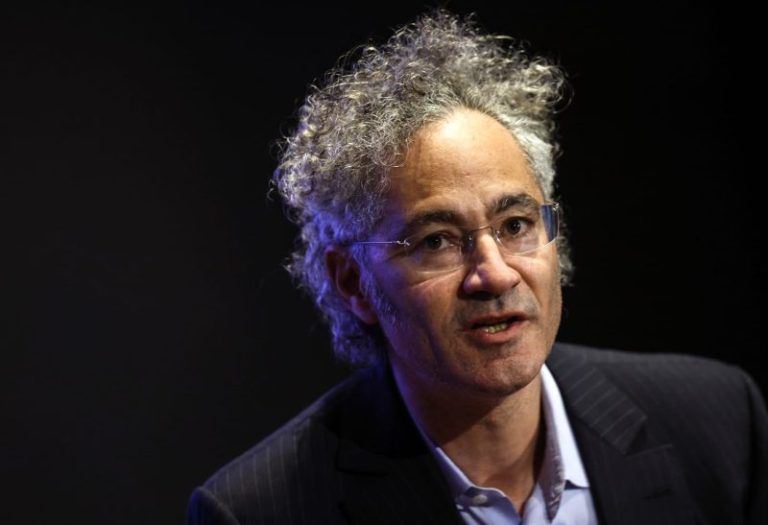
Palantir has hit another major milestone in its meteoric stock rise. It’s now one of the 20 most valuable U.S. companies.
The provider of software and data analytics technology to defense agencies saw its stock rise about 3% on Friday to another record, lifting the company’s market cap to $375 billion, which puts it ahead of Home Depot and Procter & Gamble. The company’s market value was already higher than Bank of America and Coca-Cola.
Palantir has more than doubled in value this year as investors ramp up bets on the company’s artificial intelligence business and closer ties to the U.S. government. Since its founding in 2003 by Peter Thiel, CEO Alex Karp and others, the company has steadily accrued a growing list of customers.
Revenue in Palantir’s U.S. government business increased 45% to $373 million in its most recent quarter, while total sales rose 39% to $884 million. The company next reports results on Aug. 4.
Earlier this year, Palantir soared ahead of Salesforce, IBM and Cisco into the top 10 U.S. tech companies by market cap.
Buying the stock at these levels requires investors to pay hefty multiples. Palantir currently trades for 273 times forward earnings, according to FactSet. The only other company in the top 20 with a triple-digit ratio is Tesla at 175.
With $3.1 billion in total revenue over the past year, Palantir is a fraction the size of the next smallest company by sales among the top 20 by market cap. Mastercard, which is valued at $518 billion, is closest with sales over the past four quarters of roughly $29 billion.
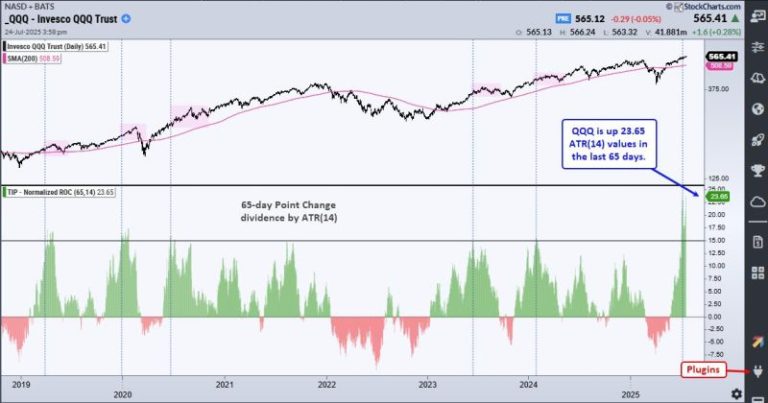
Here are some charts that reflect our areas of focus this week at
Even though the Utilities SPDR (XLU) cannot keep pace with the Technology SPDR (XLK) and Communication Services SPDR (XLC), it is in a leading uptrend. XLU formed a cup-with-handle from November to July and broke to new highs the last two weeks. ETFs hitting new highs are in strong uptrends and should be on our radar.
In a tribute to Ozzy, metals are leading the way higher in 2025. The PerfChart below shows year-to-date performance for the continuous futures for 12 commodities. Copper, Platinum and Palladium are up more than 45% year-to-date, while Gold is up 28.38% and Silver is up 35.30%. QQQ is up 10.52% year-to-date, but lagging these metals. The other commodities are mixed.
The next chart shows 11 year bar charts for five metals. Gold broke out in early 2024 and led the metals move with an advance the last 21 months. Silver and copper broke out to multi-year highs. Platinum broke above its 2021 high and Palladium got in the action with an 18 month high. There is a clear message here: metals are moving higher and leading as a group.
The Home Construction ETF (ITB) hit its moment of truth as it rose to its falling 40-week SMA. Notice that ITB failed just below this moving average in August 2023. During the 2023-2024 uptrend, the 40-week SMA was more friendly as ITB reversed near this level in October 2023 and June 2024. ITB surged to the falling 40-week SMA in July, but the long-term trend is down and this area could be its nemesis.
Thanks for Tuning in!
See TrendInvestorPro.com for more…

Here’s a quick recap of some of the most impactful resource sector news items for the week.
The period saw three miners rescued after 60 hours underground at the Red Chris mine in BC, the US announce a mine waste recovery strategy and the Ontario government add C$7 million to boost critical minerals innovation.
Three miners trapped underground at Newmont’s (TSX:NGT,NYSE:NEM) Red Chris copper-gold mine in British Columbia have been safely rescued after more than 60 hours.
The workers were sheltered in a MineARC chamber with access to food, water, and communication, following a series of rockfalls.
The rescue effort, which included drilling a 100-meter access tunnel, concluded successfully, with all miners reported in good health.
We are relieved to share that all three individuals are safe, and in good health and spirits. They had consistent access to food, water, and ventilation whilst they remained in place in a refuge chamber underground over the last two days,” a Newmont statement read. They are now being supported by medical and wellness teams. Their families have been notified.”
Investigations into the cause of the rockfalls are ongoing.
The US government is ramping up efforts to recover critical minerals from mine waste, with the Department of the Interior announcing plans to map legacy tailings across federal lands.
The initiative is part of a broader push to secure domestic supplies of essential minerals like lithium, cobalt, and rare earths.
By tapping into existing waste sites, the US hopes to reduce reliance on foreign imports while minimizing new environmental disruptions.
“By streamlining regulations for extracting critical minerals from mine waste, we are unleashing the full potential of America’s mineral resources to bolster national security and economic growth,” said Acting Assistant Secretary of Lands and Minerals Adam Suess. “This proactive approach will attract private investment, support environmental reclamation, and pave the way for mineral independence.”
The move aligns with ongoing federal investment into clean energy and supply chain resilience.
Chinese mining giant Zijin Mining Group (OTC Pink:ZIJMF,HKEX:2899,SHA:601899) is reportedly leading the race to acquire Barrick Mining’s (TSX:ABX,NYSE:B) Tongon gold mine in Côte d’Ivoire.
Barrick has tapped TD Securities and Australia-based Treadstone Resource Partners to advise on the sale of Tongon. The operation produced 148,000 ounces of gold in 2024.
With resources depleting, the mine is expected to enter care and maintenance by 2027.
Sources say the bid could be valued near US$500 million as Barrick shifts its focus toward copper and lithium assets.
The potential deal signals ongoing Chinese interest in African gold assets and underscores Barrick’s strategic pivot toward energy transition materials.
No final agreement has been announced.
Panther Minerals (CSE:PURR,OTC:GLIOF,FWB:2BC) has officially ended its option to acquire the Boulder Creek uranium project in Alaska’s Cape Nome District.
The company chose not to proceed with its next annual payment, leading to the automatic termination of the agreement signed in April 2024.
All 140 associated mining claims have been returned to Tubutulik Mining Company LLC via a quitclaim deed.
While Panther completed preliminary assessments and a site review, it opted not to advance the project further, citing seasonal, logistical, and capital constraints.
The project had drawn criticism from local Indigenous groups concerned about environmental impacts.
The Ontario government is committing over C$7 million to expand its Critical Minerals Innovation Fund (CMIF), aiming to boost research, development and commercialization across the province’s mining sector.
The new funding round—open for applications from July 23 to October 1—targets innovation in deep exploration, mineral recovery, battery supply chains and mining technologies.
This latest investment brings total CMIF funding to C$27 million since its 2022 launch, supporting more than two dozen projects to date.
The CIMF also aligns with Ontario’s broader Critical Minerals Strategy, which seeks to strengthen domestic supply chains and reduce reliance on foreign sources, especially amid growing global demand and looming US tariffs.
“With global demand for critical minerals soaring – and new US tariffs targeting Canada’s mining and manufacturing sectors – Ontario is taking action to accelerate growth and innovation in Ontario’s mining sector,’ said Stephen Lecce, Minister of Energy and Mines.
He added: “Through the Critical Minerals Innovation Fund, we are putting Ontario first, building a made-in-Canada supply chain that attracts investment and creates good-paying jobs here at home.”
Looking down the supply chain, the Ontario government is also investing C$500 million in the creation of a new Critical Minerals Processing Fund to “provide financial support for projects that accelerate the province’s critical mineral processing capacity and made-in-Ontario critical minerals supply chain.”
Securities Disclosure: I, Georgia Williams, hold no direct investment interest in any company mentioned in this article.

Statistics Canada released its monthly mineral production report for May 2025 on Monday (July 21). The data shows that the production of both copper and silver increased from April. Copper output rose to 36.3 million kilograms from 35.85 million in April, and silver increased to 26,502 kilograms from 25,412. Meanwhile, gold production decreased marginally to 16,518 kilograms from 16,640 the previous month.
However, shipments were up across the board. Copper shipments rose to 34.34 million kilograms compared to 30.01 million kilograms in April. Silver increased to 26,376 kilograms, up considerably from 22,106 kilograms a month earlier. Gold shipments saw a slighter gain, rising to 14,858 kilograms from 14,660 kilograms in April.
The report comes amid heightened uncertainty due to tariff threats from the United States.
On Friday (July 25), President Donald Trump stated that the US and Canada may not reach a new trade deal, implying that there may not be further negotiations, and suggested that Canada may “just pay tariffs.”
Earlier in the month, the White House sent letters to several nations, informing them that tariffs would take effect on August 1 if no deal was reached before that time. The US threatened Canada with a 35 percent tariff on all goods not covered under the current Canada-United States-Mexico Agreement (CUSMA), which was negotiated during Trump’s first term in office.
The president’s remarks come after Canadian Trade Minister Dominic LeBlanc said that he felt encouraged following meetings earlier in the week with US representatives, including Commerce Secretary Howard Lutnick.
In Canada, equity markets were positive this week. The S&P/TSX Composite Index (INDEXTSI:OSPTX) gained 0.29 percent to close at 27,494.35 on Friday, setting a new all-time high, while the S&P/TSX Venture Composite Index (INDEXTSI:JX) rose 0.55 percent to 801.13. The CSE Composite Index (CSE:CSECOMP) was the largest gainer, jumping 3.87 percent to 132.89.
As for US equity markets, the S&P 500 (INDEXSP:INX) gained 1.18 percent to 6,388.65 and the Nasdaq 100 (INDEXNASDAQ:NDX) climbed 0.62 percent to 23,285.57, with both closing the week setting new all-time highs. The Dow Jones Industrial Average (INDEXDJX:.DJI) rose 0.74 percent to 44,901.93, closing in on its record of 45,014 set on December 4, 2024.
In precious metals, the gold price was flat, ending the week down slightly at US$3,337.31 by Friday at 4 p.m. EDT. Meanwhile, the silver price continued to trade near 11-year highs mid-week, but fell to finish the week flat at US$38.15 per ounce.
In base metals, copper posted a 3.93 percent gain, trading near all time highs at US$5.82 per pound. The S&P GSCI (INDEXSP:SPGSCI) registered a 0.75 percent loss to finish the week at 545.08
How did mining stocks perform against this backdrop?
Take a look at this week’s five best-performing Canadian mining stocks below.
Stock data for this article was retrieved at 4 p.m. EDT on Friday using TradingView’s stock screener. Only companies trading on the TSX, TSXV and CSE with market capitalizations greater than C$10 million are included. Mineral companies within the non-energy minerals, energy minerals, process industry and producer manufacturing sectors were considered.
Weekly gain: 66.67 percent
Market cap: C$414.68 million
Share price: C$0.5
St. Augustine Gold and Copper is a development company focused on its King-king copper-gold project in the Philippines’ Davao de Oro province. The project consists of 184 mining claims.
According to the latest preliminary economic assessment from 2013, the company projects an after-tax net present value of US$1.78 billion, with an internal rate of return of 24 percent and a payback period of 2.4 years using a base case scenario of a copper price of US$3.00 per pound and a gold price of US$1,250 per ounce.
The company is currently working toward an update to the study.
On May 30, St. Augustine announced that it had entered into an agreement with the National Development Corporation (Nadecor) to acquire a 100 percent interest in Nadecor’s wholly owned subsidiary Kingking Milling, which holds the development rights to King-king.
Under the terms of the deal, Nadecor will receive C$9.02 million convertible into 185 million shares.
The project’s exploration and development permits are held by Kingking Mining, which remains a 40/40/20 joint venture between St. Augustine, Nadecor and Queensberry Mining and Development. The release also includes details of new ore sales and royalty agreements between Kingking Milling and Kingking Mining.
The company announced its latest news on Friday, reporting that it had closed a private placement, raising gross proceeds of C$24.9 million. In the announcement, the company said it intends to use the funds to advance development at King-king.
Additionally, the company reported on Thursday that Nicolaos Paraskevas and Andrew J. Russell had joined the board of directors. It notes that Paraskevas has experience in supervising business development activities in the copper industry, while Russell is one of the original founders of St. Augustine and brings two decades of experience in mining management. The announcement also reported that Love D. Manigsaca had been appointed as St. Augustine’s new CFO.
Weekly gain: 62.12 percent
Market cap: C$19.66 million
Share price: C$0.30
Kapa Gold is an exploration company focused on advancing the past-producing Blackhawk gold mine in San Bernardino County, California.
The project site is composed of seven patented and 178 contiguous federal lode claims covering 1,496.2 hectares. The property hosts multiple mineralized zones with previous exploration work revealing deposits with high grade gold, silver, lead and zinc. Historic production from ramps and underground mines has graded an average 10 grams per metric ton (g/t) gold.
Kapa’s most recent news from the project was reported on March 5, when it announced it had initiated biological surveys in advance of exploration activities on the site and submitted the requested bonding to San Bernardino County, allowing for drilling on patented claims at Blackhawk.
Weekly gain: 47.3 percent
Market cap: C$47.28 million
Share price: C$1.09
North Peak Resources is an exploration company working to advance its Prospect Mountain Mine Complex in Central Nevada, US.
The property comprises 221.9 acres of patented claims and 1,905 acres of unpatented claims, consolidating several historical mines that have hosted operations dating back to the 1870s.
Despite the extensive history of the property, limited modern exploration work has been conducted, and a technical report from April 2023 notes that no mineral resource estimate has been produced. Part of the property is currently covered by a plan of operation that entitles North Peak to carry out surface exploration, infrastructural works and underground mining of up to 331,000 metric tons per year.
The most recent exploration update from the property was released on May 27, when North Peak announced results from samples collected from underground and surface historical occurrences. Highlights included grades of 45.6 g/t gold, 569 g/t silver, 4.09 percent lead and 3.12 percent zinc over 15 cm from channel samples of in-situ material from the Dean Cave area; and 5.3 g/t gold, 39 g/t silver, 7.03 percent lead and 1.92 percent zinc from dump grab samples collected from the Kit Carson mine.
The latest news from the company came on Monday, when North Peak announced it had acquired the remaining 20 percent stake in the property from Solarljos in exchange for 3 million common shares. North Peak purchased its original 80 percent interest in the property in August 2023.
Weekly gain: 46.15 percent
Market cap: C$92.46 million
Share price: C$0.475
NextSource Materials is a mining and exploration company focused on advancing its Molo graphite mine to Phase 2 production.
The mine is located in Southern Madagascar and has a nameplate capacity of 11,000 metric tons per year, with a fixed carbon content between 94 percent and 97 percent. The company is currently working towards a Phase 2 expansion at the mine, which will increase capacity to 150,000 metric tons per year. NextSource expects to complete an updated feasibility study for the project by the end of Q3 2025.
The company is also developing a series of battery anode facilities in key geographic locations. The facilities will be designed with modular production capacities that are intended to expand in line with automotive demand.
The most recent announcement from NextSource came on June 2, when it announced its withdrawal from its battery anode facility option in Mauritius, instead planning to develop a larger-scale facility in the Middle East, which would help streamline permitting and increase access to EV manufacturers. The company stated it is advancing discussions with EV manufacturers for potential offtake agreements.
Weekly gain: 44.44 percent
Market cap: C$10.3 million
Share price: C$0.065
Bemetals is a gold and copper explorer advancing its Pangeni copper project in Zambia.
The project is located in Northwestern Zambia along the western edge of the Central African Copperbelt. BeMetals has been actively exploring the property since 2020 and identified several areas with copper mineralization.
The most recent update from the property came on March 25 when the company reported that it had commenced a new 2,000 meter to 2,500 meter drilling program to identify additional zones of copper mineralization and expand the existing footprint within the D-Prospect area.
Previous exploration at the site has yielded highlighted assays with up to 0.74 percent copper and 533 parts per million (ppm) cobalt over 16.16 meters, including an intersection of 0.93 percent copper and 701 ppm cobalt over 5.5 meters.
On July 10, BeMetals announced that it had entered into a non-binding letter of intent with Prospector Metals (TSXV:PPP,OTCQB:PMCOF) to acquire up to a 100 percent stake in the Savant gold project in Northwestern Ontario, Canada. The property covers an area of 232 square kilometers and hosts numerous gold occurrences. Under the terms of the agreement, BeMetals has agreed to meet certain milestones, including the production of a mineral resource estimate.
Final ownership share will be determined by the size of the reported resource. If the reported resource is under 500,000 ounces of contained gold, Prospector will retain full ownership. If it is between 500,000 and 1 million ounces, Prospector and BeMetals will form a 50/50 joint venture. Lastly, if the resource is over 1 million ounces, with at least 500,000 ounces in the indicated category, BeMetals will earn the full 100 percent interest, with Prospector holding a 0.5 percent net smelter royalty.
The TSX, or Toronto Stock Exchange, is used by senior companies with larger market caps, and the TSXV, or TSX Venture Exchange, is used by smaller-cap companies. Companies listed on the TSXV can graduate to the senior exchange.
As of February 2025, there were 1,572 companies listed on the TSXV, 905 of which were mining companies. Comparatively, the TSX was home to 1,859 companies, with 181 of those being mining companies.
Together the TSX and TSXV host around 40 percent of the world’s public mining companies.
There are a variety of different fees that companies must pay to list on the TSXV, and according to the exchange, they can vary based on the transaction’s nature and complexity. The listing fee alone will most likely cost between C$10,000 to C$70,000. Accounting and auditing fees could rack up between C$25,000 and C$100,000, while legal fees are expected to be over C$75,000 and an underwriters’ commission may hit up to 12 percent.
The exchange lists a handful of other fees and expenses companies can expect, including but not limited to security commission and transfer agency fees, investor relations costs and director and officer liability insurance.
These are all just for the initial listing, of course. There are ongoing expenses once companies are trading, such as sustaining fees and additional listing fees, plus the costs associated with filing regular reports.
Investors can trade on the TSXV the way they would trade stocks on any exchange. This means they can use a stock broker or an individual investment account to buy and sell shares of TSXV-listed companies during the exchange’s trading hours.
Article by Dean Belder; FAQs by Lauren Kelly.
Securities Disclosure: I, Dean Belder, hold no direct investment interest in any company mentioned in this article.
Securities Disclosure: I, Lauren Kelly, hold no direct investment interest in any company mentioned in this article.