Author

admin

Browsing

Here’s a quick recap of the crypto landscape for Monday (July 7) as of 9:00 p.m. UTC.

Get the latest insights on Bitcoin, Ethereum and altcoins, along with a round-up of key cryptocurrency market news.

Bitcoin and Ethereum price update

Bitcoin (BTC) is priced at US$108,159, a 0.3 percent decline in the last 24 hours. The day’s range for the cryptocurrency brought a low of US$107,591 and a high of US$108,551.

Bitcoin price performance, July 7, 2025.

Chart via TradingView.

Bitcoin hovered near US$109,000 at the start of the day as investors shifted from equities to crypto in response to tariff-related uncertainty under US President Donald Trump.

Meanwhile, MicroStrategy’s (NASDAQ:MSTR) paused its weekly Bitcoin purchases for the first time since March, signaling a strategic reassessment amid recent volatility. Together, macro pressures and institutional moves helped support Bitcoin’s price.

Ethereum (ETH) is priced at US$2,546.07, up by 0.2 percent over the past 24 hours. Its lowest valuation as of Monday was US$2,521, and its highest was US$2,553.

Altcoin price update

  • Solana (SOL) was priced at US$149.11, down by 1.3 percent over 24 hours. Its lowest valuation as of Monday was US$149.21, and its highest was US$153.06.
  • XRP was trading for US$2.30, up 1.6 percent in the past 24 hours. The cryptocurrency’s lowest valuation was US$2.28, and its highest was US$2.30.
  • Sui (SUI) is trading at US$2.87, down by 0.7 percent over the past 24 hours. Its lowest valuation was US$2.84 and its highest was US$2.92.
  • Cardano (ADA) is priced at US$0.5847, down by 0.4 percent in the last 24 hours. Its lowest valuation as of Monday was US$0.5764, and its highest was US$0.589.

Today’s crypto news to know

CoreWeave to acquire Core Scientific for US$9 billion

CoreWeave (NASDAQ:CRWV) signed a definitive agreement to acquire Core Scientific (NASDAQ:CORZ) in an all-stock deal valued at US$9 billion, the company announced today. Core Scientific’s shareholders will receive 0.1235 shares of CoreWeave Class A common stock for each share of Core Scientific, representing a 66 percent premium over Core Scientific’s June 25 closing price of US$12.30.

The deal had been in the works for over a year. A US$1 billion bid made by CoreWeave in 2024 was initially rejected as too low, but the Wall Street Journal reported in June 2025 that discussions between the two companies had resumed.

“This acquisition accelerates our strategy to deploy AI and (high-performance computing) workloads at scale,” said Michael Intrator, CoreWeave’s CEO, Chair and co-founder. “Verticalizing the ownership of Core Scientific’s high-performance data center infrastructure enables CoreWeave to significantly enhance operating efficiency and de-risk our future expansion.”

Bit Digital shifts corporate treasury from Bitcoin to Ether

Digital asset firm Bit Digital (NASDAQ:BTBT) has shifted its corporate treasury from Bitcoin to Ether, according to an announcement made by the company on Monday.

The change was punctuated by a purchase of more than 75,000 ETH tokens, funded by the sale of 280 Bitcoin and proceeds raised during a recent public offering that brought in US$172 million.

According to the announcement, Bit Digital held 24,434 ETH prior to the offering, and the additional ETH acquisition has brought the company’s total to approximately 100,603 ETH. This move establishes Bit Digital as the second-largest corporate holder of ETH after Coinbase Global, according to CoinGecko data.

Following this news, Bit Digital’s stock closed over 18 percent higher, and its market capitalization temporarily rose above US$1 billion.

The Blockchain Group and Smarter Web Company expand Bitcoin holdings

On the other hand, France’s The Blockchain Group (EPA:ALTBG) and the United Kingdom’s Smarter Web Company (AQSE:SWE) expanded their Bitcoin holdings today.

In a Monday announcement, The Blockchain Group said it acquired 116 BTC for about 10.7 million euros, bringing its total holdings to 1,904 BTC.

The Smarter Web Company announced its purchase of 226.42 BTC for 17.9 million pounds, bringing the company’s total to 1,000 BTC.

SEC’s crypto ETF guidance signals mainstream shift

The US Securities and Exchange Commission took a major step toward regulating crypto exchange-traded products with its first formal guidance on crypto ETP disclosures, according to a Reuters analysis.

Issued last week, the 12 page document issues new guidance, stating firms should describe risks and custody arrangements in “plain English.” The document could speed up approval of dozens of new crypto ETFs tied to a variety of coins, including Solana, XRP and even Trump’s meme coin, Reuters states.

Anonymous insiders told Reuters the SEC is also developing a more standardized listing rule to replace the case-by-case exemptions that currently delay launches. That change could shrink approval timelines from 240 days to as little as 75.

Musk’s America Party goes all-in on Bitcoin, calls fiat ‘hopeless’

Elon Musk confirmed that his newly formed America Party will officially embrace Bitcoin after declaring that “fiat is hopeless” in a post on X.

The move follows Musk’s earlier hints at increasing his own Bitcoin exposure and praising Bitcoin as a hedge against traditional currency.

Musk was a significant figure in Trump’s reelection campaign and even headed the Department of Government Efficiency before splitting with Trump over his budget bill and creating the America Party.

The shift could inject more digital asset discussions into US politics as Musk tries to build a third-party movement.

Despite hype from Dogecoin supporters, no plans for DOGE adoption were announced.

Metaplanet boosts Bitcoin stash past 15,500 BTC

Japan’s Metaplanet (OTCQX:MTPLF,TSE:3350) disclosed this week that it purchased another 2,205 BTC at an average price of 15.64 million yen per coin, spending around US$213 million.

This purchase brings the firm’s total bitcoin holdings to 15,555 BTC, making Metaplanet one of the world’s largest corporate holders of the asset.

The company tracks a proprietary metric called BTC Yield, measuring the effect of share dilution on per-share bitcoin value.

For the second quarter, Metaplanet reported a BTC yield of 95.6 percent, down from 309.8 percent the previous quarter, but still strong enough to highlight aggressive growth.

Metaplanet’s total BTC investment now tops US$1.38 billion.

Securities Disclosure: I, Giann Liguid, hold no direct investment interest in any company mentioned in this article.

Securities Disclosure: I, Meagen Seatter, hold no direct investment interest in any company mentioned in this article.

This post appeared first on investingnews.com

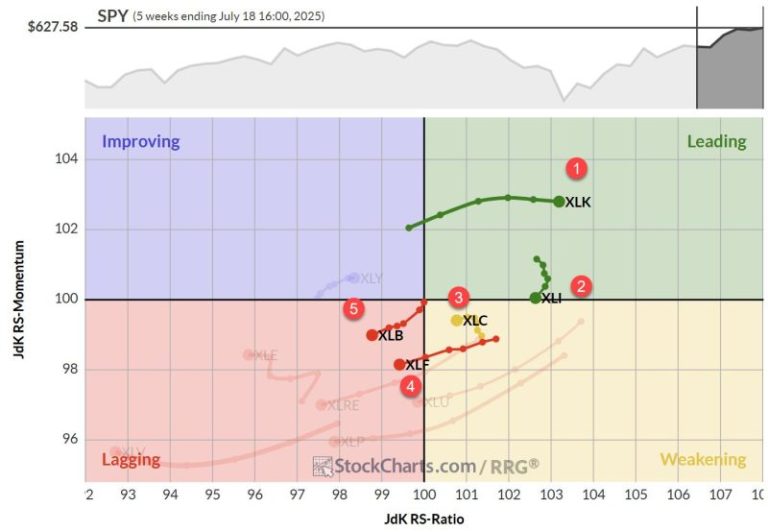
The past week has been relatively stable in terms of sector rankings, with no new entrants or exits from the top five. However, we’re seeing some interesting shifts within the rankings that warrant closer examination. Let’s dive into the details and see what the Relative Rotation Graphs (RRGs) are telling us about the current market dynamics.

Sector Rankings Shuffle

The top three sectors, technology, industrials, and communication services, remain firmly entrenched in their positions. But the real action is happening just below them. Financials climbed to the number four spot, consequently pushing utilities down to fifth place. This shift is significant, as it indicates a move towards more cyclical sectors in the top rankings.

These changes suggest a potential shift towards more economically sensitive and offensive sectors, which supports a bullish scenario or at least a move away from defensive positioning.

  1. (1) Technology – (XLK)
  2. (2) Industrials – (XLI)
  3. (3) Communication Services – (XLC)
  4. (5) Financials – (XLF)*
  5. (4) Utilities – (XLU)*
  6. (8) Materials – (XLB)*
  7. (7) Consumer Staples – (XLP)
  8. (6) Real-Estate – (XLRE)*
  9. (10) Consumer Discretionary – (XLY)*
  10. (9) Energy – (XLE)*
  11. (11) Healthcare – (XLV)

Weekly RRG

The weekly Relative Rotation Graph continues to show strength in the technology sector within the leading quadrant. Industrials is also maintaining its position in the leading quadrant, with a very short tail, indicating a consistent relative uptrend.

Communication services, financials, and utilities are currently in the weakening quadrant. However, communication services have rebounded and appear to be making their way back towards the leading quadrant again.

Financials and utilities, on the other hand, are showing negative headings, with utilities displaying the weakest momentum (longest tail).

Daily RRG

Switching to the daily RRG, we get a more granular view of recent sector movements:

  • Technology remains the strongest sector, with a high RS ratio and a short tail
  • Communication services are rotating at a slightly negative heading but still within the leading quadrant
  • Financials and industrials are showing promise in the improving quadrant
  • Utilities continues to rotate within the lagging quadrant, confirming its weakness

The positioning of these sectors, particularly the strength of technology and improvements in financials and industrials, suggests a shift towards more cyclical and less defensive sectors in the market.

Technology

Tech continues its rally after breaking above the $240 resistance area. The raw RS line is also climbing, having broken out of its falling channel. This sector remains the market leader and shows no signs of slowing down.

Industrials

The industrial sector has cleared its overhead resistance and is pushing higher. Its RS line is putting in new highs, reflecting strong relative performance. The RRG lines remain in the leading quadrant and may be turning up again, a bullish sign.

Communication Services

Comms have broken above their resistance around 105. While still at the lower boundary of its rising RS channel, it’s starting to pick up steam. Both RRG lines are climbing, with RS momentum approaching the 100 level. A cross above that level would put it back in the leading quadrant.

Financials

Financials broke through overhead resistance last week, which is a significant positive development. It’s now above both horizontal resistance and its former support line. The relative strength line needs some work, but with the current price breakout, improvement seems likely in the near future.

Utilities

The weak link in the top five, utilities, remains range-bound. It’s still above support, but not by much. With the broader market rising, utilities’ sideways movement is causing its RS line to drop. The RRG lines are rolling over, and we may soon see this sector rotate into the lagging quadrant on the weekly RRG.

Portfolio Performance Update

I must admit, our portfolio is still underperforming. The current drawdown is a little over 8%, which isn’t ideal. However, this is the nature of trend-following strategies. We’re sticking with our approach through this period of underperformance, confident that historical results support our patience.

If market trends continue as they are, we should see more offensive sectors rotate into the top five. This shift, in turn, should help us overcome the current drawdown and eventually bring us ahead of the S&P again.

Remember, investing is a marathon, not a sprint. Periods of underperformance are normal and to be expected. The key is to stay disciplined and trust in your strategy.

#StayAlert and have a great week. –Julius


The gold price continued to surge to new record highs in the second quarter of the year, reaching an all-time high of C$4,663.85 per ounce, or US$3,433.47, on June 13.

The gains were primarily fueled by safe-haven investment as Israel and the United States launched attacks on Iranian nuclear sites and Iran retaliated against targets in Israel and a US base in Qatar. Although a ceasefire was announced, tensions in the region remain high.

Additional tailwinds come from the continuing uncertainty in global financial markets, stemming from shifting US trade policy and Donald Trump’s ongoing, on-again-off-again tariff plans.

There is also additional uncertainty going into the second half of the year as the US government passed its “Big Beautiful Bill” on July 3. The bill has been criticized from both sides, including the former head of the Department of Government Efficiency, Elon Musk, for increasing deficit spending and exacerbating an already ballooning debt, which some investors believe is driving the US toward a debt crisis.

What does this mean for junior gold companies? While there was delay in translating high gold prices into share price gains for gold explorers, many are now up significantly this year. Below, we profile the five TSXV gold companies that are the best performers of 2025 by year-to-date share price gains.

Data for this article was retrieved on July 3, 2025, using TradingView’s stock screener, and only companies with market capitalizations greater than C$10 million are included.

1. Onyx Gold (TSXV:ONYX)

Year-to-date gain: 846.34 percent
Market cap: C$122.48 million
Share price: C$1.94

Onyx Gold is an exploration company advancing its Munro-Croesus project, located near Timmins in Ontario, Canada. The company has increased the size of the land package by 200 percent between 2020 and 2025, and the project now covers an area of 109 square kilometers.

Munro-Croesus hosts the historic Croesus mine, which produced 14,859 ounces of gold between 1915 and 1936 with an average grade of 95.3 grams per metric ton (g/t). Onyx is the first company to explore the property since the mine closed.

Shares in Onyx have had significant gains in the second quarter of 2025. The momentum came as the company announced option agreements to enlarge its land package at Munro-Croesus.

The first announcement came on April 10, when it stated that it had agreed with private vendors to acquire a 21 hectare patented claim near the Argus North zone. Under the terms of the agreement, Onyx has the option to acquire a 100 percent interest in the property, which has never been drilled, in exchange for cash consideration of C$1.5 million and 3.3 million Onyx shares over a three-year period.

The second acquisition was announced on June 24, when Onyx reported that it signed a mineral property purchase and sale agreement to acquire a 100 percent interest in the Munro and Hewitt properties, both located near the existing Munro-Croesus project. The acquisition will expand the company’s land package from 95 to 109 square kilometers.

Alongside its land consolidations, Onyx has also spent the second quarter advancing exploration at the property.

Most recently, on June 26, the company reported the first drill results from its 10,000 meter spring drill program at the Argus North zone at Munro-Croesus. One highlighted assay contained 1.8 grams per metric ton (g/t) gold over 91 meters, including 4 g/t over 32 meters and 5.3 g/t over 17 meters.

The company said the results demonstrate the continuity of broad zones of high-grade gold mineralization.

Shares in Onyx reached a year-to-date high of C$2.09 on June 27.

2. Goldgroup Mining (TSXV:GGA)

Year-to-date gain: 500 percent
Market cap: C$217.34 million
Share price: C$0.99

Goldgroup Mining is a gold production, development and exploration company working to advance its Cerro Prieto heap-leach gold mine. The 4,335 hectare property, located in Sonora, Mexico, produces an annual average of 11,500 ounces of gold and has produced more than 120,000 ounces since its beginning in March 2013.

Goldgroup is currently working to double the capacity of the mine to more than 25,000 ounces per year. The last update on progress came in October 2024, when it announced that it had installed the primary crusher with a 2,200 metric ton per day throughput. It also said it had expanded pumping and irrigation capacity.

The most recent update on Cerro Prieto came on March 26, when Goldgroup announced high-impact exploration near the mine. The program will include 6,000 meters of diamond drilling focused on the Nuevo Esperanza and Reyna zones, which are next to the main Esperanza production zone.

The company also announced plans for an induced polarization geophysical survey and surface trenching 1 kilometer south of the mine to further investigate newly discovered mineralized zones.

In addition to activities at Cerro Prieto, the company announced on March 7 that it had entered an agreement to acquire Minera Apolo and its Pinos gold project from Candeleria Mining in exchange for settling a US$2.7 million loan facility. Goldgroup previously secured rights to the facility with Candeleria from a creditor group in a maneuver to acquire the project.

Pinos is a fully permitted gold project situated in the Zacatecas mining belt of Northern Mexico and comprises 29 concessions over 3,816 hectares. A 2018 PEA revealed an after-tax net present value of US$12 million, with a 25 percent internal rate of return at a gold price of US$1,250 per ounce.

Shares in Goldgroup reached a year-to-date high of C$1.08 on May 9.

3. Trident Resources (TSXV:ROCK)

Year-to-date gain: 400 percent
Market cap: C$19.62 million
Share price: C$0.75

Trident Resources, formerly Eros Resources, is a gold and copper exploration company focused on projects in Saskatchewan, Canada.

A three-way merger in early 2025 between Eros Resources, MAS Gold and Rockridge Resources, allowed the companies to consolidate a portfolio of assets in Saskatchewan, including the Contact Lake and Greywacke gold projects in the La Ronge gold belt as well as the Knife Lake copper project.

Before this year, Eros was focused on the Bell Mountain gold-silver project in Nevada, US, but on January 6, the company announced it had sold the property to Lincoln Gold Mining (TSXV:LMG) in exchange for up to 4.5 million common shares and a net profits interest of 7.5 percent of net returns from gold and silver produced at the project to a maximum of US$2 million.

The company announced its rebranding from Eros to Trident on April 23, with its new name chosen in part to represent the three companies joining together. In the release, the company stated that the rebrand marked the beginning of a new chapter for the company, underscoring its focus on the gold and copper markets.

On May 6, Trident announced it received drill permits for the Contact Lake project, marking the first project news following the rebrand.

Trident stated the drill program would be conducted over the summer and consist of approximately 5,000 meters, with 3,800 meters to be carried out at the Contact Lake deposit and 1,200 meters at the Preview SW deposit.

Shares in Trident reached a year-to-date high of C$0.75 on July 3.

4. Solstice Gold (TSXV:SGC)

Year-to-date gain: 333 percent
Market cap: C$15.28 million
Share price: C$0.065

Solstice Gold is an exploration company focused on advancing its flagship Strathy gold project in Ontario, which it acquired in June 2024.

The project consists of 45 claims covering an area of 45 square kilometers in the Temagami Greenstone belt. Historical documents report six gold showings in the central portion of the project areas, with documented mineralization at the Leckie prospect.

On January 15, Solstice announced results from an induced polarization survey of the property. It identified 50 new targets, with the highest priority targets being along strike on the Leckie Fault. The company stated that the results support the existence of an extensive, largely unexplored system, with potential for multiple discoveries.

Solstice said it had also been selected to receive a grant under the Ontario Junior Exploration Program from the provincial government. The grant will provide 50 percent of the exploration funding, up to a maximum of C$194,000.

Shares in Solstice gained early in the year following its January 20 announcement that Michael Gentile had increased his stake in Solstice to 16.76 percent, making him the single largest shareholder.

In its latest project update on July 2, Solstice announced it had wrapped up its spring drill program, which focused on four target areas. In total, the company completed 3,125 meters of drilling across 14 holes, and results are expected in July.

The company reported that it had entered into an agreement to acquire 17 additional claims, which would increase the project area by 50 percent. It added that targets identified from its IP program may extend along strike into these claims.

Shares in Solstice reached a year-to-date high of C$0.065 on June 27.

5. Lahontan Gold (TSXV:LG)

Year-to-date gain: 300 percent
Market cap: C$28.49 million
Share price: C$0.10

Lahontan Gold is a development and exploration company dedicated to advancing a portfolio of properties in Nevada, United States.

Its primary focus is on its flagship Santa Fe gold-silver project in Walker Lane. The property consists of 291 unpatented lode mining claims, 67 unpatented mill site claims, and 24 patented lode mining claims, covering a land package of 26.4 square kilometers.

On January 24, the company released a PEA for the project that demonstrated an after-tax net present value of US$56.5 million with an internal rate of return of 17.4 percent over a payback period of 4.24 years based on a gold price of US$2,025 per ounce.

The included MRE for the site reports an indicated resource of 1.44 million ounces of gold and 11.2 million ounces of silver from 48.39 million metric tons of ore at an average grade of 0.92 g/t gold and 7.18 g/t silver. It also hosts an inferred resource of 401,000 ounces of gold and 1.75 million ounces of silver from 16.76 million metric tons at a grade of 0.74 g/t gold and 3.25 g/t silver.

The most recent news from Lahontan was on March 18, when it provided an update on its Exploration Plan of Operation submitted to the Bureau of Land Management in November 2024. In the release, the company stated it expects the Bureau to approve the plan, allowing permitting to proceed to the National Environmental Policy Act phase. According to Lahontan, final approval is on track for late 2025.

In the meantime, Lahontan stated that it would be able to continue exploration drilling at its patented mining claims under a Notice of Intent (NOI). On May 6, the company filed a new NOI for additional drilling at the site that would target extensions in the Slab and York areas of the project, and the BLM approved it on June 9.

Additionally, the company announced on June 24 that it had started metallurgical test work at Santa Fe with the goal of substantially improving CN leach gold recoveries for transition materials compared to the 49 percent recovery in the PEA.

Shares in Lahontan reached a year-to-date high of C$0.105 on June 25.

Securities Disclosure: I, Dean Belder, hold no direct investment interest in any company mentioned in this article.

This post appeared first on investingnews.com
Chinese chain Luckin Coffee opened its first two U.S. locations this week, betting that mobile-only ordering and creative flavors can lure customers away from Starbucks.

Both new Luckin stores are based in Manhattan, and at the midtown location on Wednesday, Sam Liu took a sip of her jasmine cold brew.

“I’ve never tried anything like it,” she said.

I thought I just order at the counter, but I realized everyone was standing around looking at their phone.

Luckin Customer Sam Liu, New York City

Liu said she’d hoped for more seating — the small shop has only three tables — and was initially confused by Luckin’s in-app ordering system, which means customers can’t order directly from a barista.

“I thought I just order at the counter, but I realized everyone was standing around looking at their phone,” Liu said.

Luckin is China’s largest coffee chain, with more than twice as many locations as Starbucks there. Its two New York City stores are its first foray outside Asia, where it has over 24,000 locations across the region. By comparison, there are over 17,000 Starbucks in the United States.

Its CEO, Guo Jinyi, called the U.S. “a strategically important market” for the company’s expansion in a press release heralding the two new locations Wednesday. “We are excited to introduce a diverse and unique coffee experience to American consumers.”

The company, which didn’t respond to a request for comment, has touted its ambitions to expand globally but hasn’t publicly detailed its next moves in the U.S. or other markets.

The chain has gained success overseas through creative drinks like alcohol-infused coffees and fruit lattes, along with its smartphone-centric ordering model. The app-based approach makes it easier to track inventory, send personalized appeals to consumers and serve drinks quickly, said John Zolidis, an analyst who tracks Luckin and Starbucks at the brokerage firm he founded, Quo Vadis Capital.

“Luckin was able to develop an incredible muscle with regard to product innovation, and they have been very creative in China,” he said.

Drink orders ready for pickup or delivery inside one of the Manhattan Luckin shops on Monday.Anthony Behar / Sipa USA via AP

Zolidis said how Luckin fares on Starbucks’ home turf will depend on its ability to differentiate its menu from other major U.S. coffee chains and smaller, independent cafes. Its American lineup already includes distinctive drinks like blood orange cold brew and coconut lattes.

“These orange drinks, or one of their most successful, a coconut cloud latte — that’s how you get trial [customers] from the U.S.,” Zolidis said.

Luckin faced financial troubles during the pandemic. It was delisted from Nasdaq in 2020 after its stock plunged following an internal investigation that found an executive had falsified revenue reports. The company filed for bankruptcy in the U.S. the following year but emerged from proceedings in 2022 and its sales have soared since, reaching $4.7 billion worldwide in fiscal year 2024, a 38.4% increase from 2023.

Luckin was able to develop an incredible muscle with regard to product innovation, and they have been very creative in China.

John Zolidis, Founder, Quo Vadis Capital

Starbucks, by contrast, is struggling in both the U.S. and China. Its same-store sales in the U.S. declined 2% and its sales in China 8% in fiscal year 2024, and it reported in April that its quarterly profit was half of what it pulled in for the same period last year. The Seattle-based chain is reportedly looking to partially sell its business in China while revamping its U.S. strategy to focus on customer experience and human connection, in contrast with Luckin’s model.

“We veered away from, I think, owning the idea of the ‘third place,’ the coffeehouse experience, making sure that the customer was front and center,” Starbucks CEO Brian Niccol told NBC News in June.

A Starbucks spokesperson declined to comment.

Zolidis said that whereas Starbucks aims in both the U.S. and China to appeal to customers looking for higher-end coffee served in an inviting setting, Luckin has successfully positioned itself as the “everyman’s coffee” in China, with low prices and small, grab-and-go storefronts.

After taking the train in from Hoboken, New Jersey, to check out the new one in midtown, Samantha Coy said the trip was worth it. She had enjoyed Luckin in China previously and was eager to order one of its fruit drinks.

“I’m surprised Starbucks hasn’t tried to bring that over to the U.S.,” Coy said. “I hope they stay open.”

Zolidis said he thinks Luckin is well-positioned to gain a foothold in America.

“They’ve been able to operate and grow incredibly quickly in the Chinese market, much faster than I would have thought possible, and they’ve been able to sustain it and develop a strong financial model so they can fund their expansion in the U.S.,” Zolidis said. “They wouldn’t be coming here to try it if they didn’t think they had a shot of owning part of the market.”

This post appeared first on NBC NEWS

Indonesia’s rumbling Mount Lewotobi Laki Laki erupted Monday, sending a column of volcanic materials as high as 18 kilometers (11 miles) into the sky and depositing ash on villages.

The volcano has been at the highest alert level since last month and no casualties were immediately reported.

Indonesia’s Geology Agency recorded an avalanche of searing gas clouds mixed with rocks and lava traveling up to 5 kilometers (3 miles) down the volcano’s slopes during the eruption. Observations from drones showed lava filling the crater, indicating deep movement of magma that set off volcanic earthquakes.

The column of hot clouds that rose into the sky was the volcano’s highest since the major eruption in November 2024 that killed nine people and injured dozens, said Muhammad Wafid, the Geology Agency chief. It also erupted in March.

“An eruption of that size certainly carries a higher potential for danger, including its impact on aviation,” Wafid told The Associated Press from Switzerland where he was attending a seminar. “We shall reevaluate to enlarge its danger zone that must be cleared of villagers and tourist activities.”

The volcano monitoring agency had increased the alert status for Mount Lewotobi Laki Laki to the highest level after an eruption on June 18, and more than doubled an exclusion zone to a 7-kilometer (4.3-mile) radius since then as eruptions became more frequent.

After an eruption early last year, about 6,500 people evacuated and the island’s Frans Seda Airport was closed. The airport has remained closed since then due to the continuing seismic activity.

The 1,584-meter (5,197-foot) mountain is a twin volcano with Mount Lewotobi Perempuan in the district of Flores Timur.

Monday’s eruption was one of Indonesia’s largest volcano eruptions since 2010 when Mount Merapi, the country’s most volatile volcano erupted on the densely populated island of Java. That eruption killed 353 people and forced over 350,000 people to evacuate affected areas.

Indonesia is an archipelago of more than 280 million people with frequent seismic activity. It has 120 active volcanoes and sits along the “Ring of Fire,” a horseshoe-shaped series of seismic fault lines encircling the Pacific Basin.

This post appeared first on cnn.com

The owners of a pet lion that jumped a wall and attacked a woman and two children in the Pakistani city of Lahore have been arrested.

The woman and her two young children, aged 5 and 7, were taken to hospital, after being attacked in an alleyway when the lion escaped from a farmhouse in the neighborhood of Johan town on Thursday.

Security camera footage released by police showed the lion leaping over a concrete wall and pouncing on a woman from behind, knocking her to the ground. A man can be seen running out of the property the lion escaped from with an object in hand and chasing the lion away from the woman, before the wild cat takes off further down the road where the children were attacked.

They sustained injuries to their faces and arms but are now in stable condition, according to the Associated Press news agency.

Lahore police said in a video posted to social media that the lion had escaped from an open cage at the farmhouse and that it was recaptured by the owners, who promptly put it in a vehicle and went into hiding in another district.

Muhammad Faisal Kamran, Deputy Inspector General of Lahore Police Operations, said three people were arrested on Friday morning. “We’ve also captured the lion and transferred it to Wildlife authorities,” Kamran said.

Lahore police shared an image of three men in a police cell and video of the lion in a cage.

Owning wild cats as pets is seen as a status symbol in Pakistan and is not uncommon, but a license is required, and large cats must be kept outside city limits.

“This unfortunate incident highlights how wild animals are often kept in such places without a license, or permission — with no legal procedures followed — endangering the lives of many people,” Kamran said.

The Punjab government announced Sunday that it was undertaking a province-wide crackdown on those keeping lions without a license. So far, 13 lions have been captured and five individuals arrested in connection with violating wildlife regulations.

This post appeared first on cnn.com

I like to trade stocks that are relative leaders and belong to industry groups that are leaders as well. For the past 2-3 months, much has been written about and discussed with respect to semiconductors ($DJUSSC), software ($DJUSSW), electrical components & equipment ($DJUSEC), electronic equipment ($DJUSAI), recreational services ($DJUSRQ), travel & tourism ($DJUSTT), etc. These groups were laggards prior to showing absolute and relative strength and, many times, it’s the absolute strength (think breakout) that triggers money flows into that particular area of the market.

With that in mind, where’s one area that we could see upcoming strength during the summer months?

Computer Hardware

I know this group has been out of favor, but that seemed to change last week:

Its absolute downtrend seems to have been broken and we saw a glimpse of solid relative strength. Seasonality also leads me to believe that this run could very well just be getting started. Check this out:

Over the past 20 years, the DJUSCR has crushed the S&P 500 during the months of July and August. It’s easily been the group’s best two calendar months historically. These two months have consistently been great months for computer hardware stocks as they’ve each gained ground in roughly 3 out of every 4 years. Apple, Inc. (AAPL), the leading computer hardware stock, absolutely loves the months of July and August.

I expect last week’s rally to continue right up to AAPL’s earnings report on July 31st, and possibly beyond.

I’ll be featuring one other computer hardware stock in our FREE EB Digest newsletter on Monday morning that has CRUSHED the S&P 500 during July and August historically and it boasts one of the strongest charts in technology since the April low. If you’re not already an EB Digest subscriber, simply CLICK HERE to provide your name and email address. I’ll get that chart out to you first thing tomorrow morning!

Happy trading!

Tom


Questcorp Mining Inc. (CSE: QQQ) (OTCQB: QQCMF) (FSE: D910) (the ‘Company’ or ‘Questcorp’) is pleased to update shareholders on the on-going surface exploration in preparation for drilling at the La Union Gold-Silver Project in Sonora, Mexico. Questcorp has an Option earn a 100% interest from Riverside Resources Inc. in the 2,520 ha (25 km sq) property by making a series of cash payments and share issuance and completing a series of exploration expenditures.

Questcorp President & CEO, Saf Dhillon, stated: ‘We are pleased with the progress Riverside has made as we complete the preliminary exploration steps, in finalizing our drill targets for the upcoming maiden drill program at La Union. The decades of in country exploration experience that John-Mark and his Riverside team diligently bring to focus at the La Union project is very evident as they continue to further de-risk the up-coming 1,500 metre drill program.’

Figure 1: Cross section IP with interpreted structures and targets from Union new Induced Polarity geophysics survey.

To view an enhanced version of this graphic, please visit:
https://images.newsfilecorp.com/files/10197/257897_4d60e7d2c4556af9_001full.jpg

La Union operator Riverside Resources has successfully completed two IP lines over the La Union and La Union Norte mines respectively, highlighting chargeability and resistivity features at depth which will guide the placement of the first ever drill holes on the property, as well as correlating with mapped mineralized zones and former workings.

A drone magnetic survey was flown over the property to provide structural context, follow up potential intrusive feeders and provide information about potential faults beneath the pediments and post-mineral young cover units.

Ongoing surface geochemistry and mapping continues to strengthen the targeting pipeline, particularly across exposed gold-rich manto zones and along the margins of shallow post-mineral gravel pediment cover. These efforts are focused on delineating the transition zones from covered to exposed mineralization and establishing structural controls that may influence ore continuity at depth.

The La Union Project

The La Union Project is a carbonate replacement deposit (‘CRD’) project hosted by Neoproterozoic sedimentary rocks (limestones, dolomites, and siliciclastic sediments) overlying crystalline Paleoproterozoic rocks of the Caborca Terrane. The structural setting features high-angle normal faults and low-to-medium-angle thrust faults that sometimes served as mineralization conduits. Mineralization occurs as polymetallic veins, replacement zones (mantos, chimneys), and shear zones with high-grade metal content, as shown in highlight grades of 59.4 grams per metric tonne (g/t) gold, 833 g/t silver, 11% zinc, 5.5% lead, 2.2% copper, along with significant hematite and manganese oxides, consistent with a CRD model (see the technical report entitled ‘NI 43-101 Technical Report on the Union Project, State of Sonora, Mexico’ dated effective May 6, 2025 available under Questcorp’s SEDAR+ profile). These targets also demonstrate intriguing potential for large gold discoveries potentially above an even larger porphyry Cu district potential as the Company’s target concept at this time.

Questcorp cautions investors grab samples are selective by nature and not necessarily indicative of similar mineralization on the property.

Riverside, the operator of the La Union Project, is currently lining up the various geophysical contractors to immediately undertake orientation surveys and follow up detailed survey to confirm and enhance the drill targets.

The technical and scientific information in this news release has been reviewed and approved by R. Tim Henneberry, P. Geo (BC), a director of the Company and a ‘qualified person’ under National Instrument 43-101 – Standards of Disclosure for Mineral Projects.

About Questcorp Mining Inc.

Questcorp Mining Inc. is engaged in the business of the acquisition and exploration of mineral properties in North America, with the objective of locating and developing economic precious and base metals properties of merit. The Company holds an option to acquire an undivided 100% interest in and to mineral claims totaling 1,168.09 hectares comprising the North Island Copper Property, on Vancouver Island, British Columbia, subject to a royalty obligation. The Company also holds an option to acquire an undivided 100% interest in and to mineral claims totaling 2,520.2 hectares comprising the La Union Project located in Sonora, Mexico, subject to a royalty obligation.

Contact Information

Questcorp Mining Corp.
Saf Dhillon, President & CEO
Email: saf@questcorpmining.ca
Telephone: (604) 484-3031

This news release includes certain ‘forward-looking statements’ under applicable Canadian securities legislation. Forward-looking statements include, but are not limited to, statements with respect to Riverside’s arrangements with geophysical contractors to undertake orientation surveys and follow up detailed survey to confirm and enhance the drill targets. Forward-looking statements are necessarily based upon a number of estimates and assumptions that, while considered reasonable, are subject to known and unknown risks, uncertainties, and other factors which may cause the actual results and future events to differ materially from those expressed or implied by such forward-looking statements. Such factors include, but are not limited to: the ability of Riverside to secure geophysical contractors to undertake orientation surveys and follow up detailed survey to confirm and enhance the drill targets as contemplated or at all, general business, economic, competitive, political and social uncertainties, uncertain capital markets; and delay or failure to receive board or regulatory approvals. There can be no assurance that the geophysical surveys will be completed as contemplated or at all and that such statements will prove to be accurate, as actual results and future events could differ materially from those anticipated in such statements. Accordingly, readers should not place undue reliance on forward-looking statements. The Company disclaims any intention or obligation to update or revise any forward-looking statements, whether as a result of new information, future events or otherwise, except as required by law.

To view the source version of this press release, please visit https://www.newsfilecorp.com/release/257897

News Provided by Newsfile via QuoteMedia

This post appeared first on investingnews.com
Thousands of people gathered in India’s Dharamshala on Sunday to celebrate the 90th birthday of the Dalai Lama – a key milestone in the life of the spiritual leader and Nobel Peace laureate known for his message of compassion and his quest for greater freedoms for Tibet under Beijing’s rule.

Undeterred by heavy monsoon rain and thick fog, crowds dressed in their finery packed the narrow streets from early morning and queued in droves hoping to catch a glimpse of the Dalai Lama at the Tsuklakhang Tibetan Buddhist complex.

Hundreds of hopeful attendees were left waiting to see if they would be allowed into the temple which reached full capacity before the festivities began, and was heavily manned by Indian police and security personnel.

Masked dancers in traditional outfits twirled to the sounds of gongs, pipes and horns as the Dalai Lama was led into the complex by two attendants.

Indian government ministers were set to attend the cutting of the celebratory cake, as well as Hollywood actor Richard Gere, a longtime supporter of the Dalai Lama.

The gathering marked the culmination of a days-long celebration that brought supporters and spiritual heads to the small city in India’s Himalayan foothills, which has served as the seat of the Tibetan government-in-exile and home of the Dalai Lama since he fled Tibet during a failed 1959 uprising against Chinese communist rule.

Many had traveled far to join the celebration, such as Namgyal Dorjee Gongpa, from New Jersey in the United States.

“Every year, we take trips to India, which is the epicenter of the exile Tibetan setup so that my kids who are born in a foreign country… get back to their roots and learn and live their culture. So this is a great occasion because we can all take part in the celebration of His Holiness the Dalai Lama’s 90th birthday.”

In a birthday message on X, the Dalai Lama emphasized the importance of “achieving peace of mind through cultivating a good heart and by being compassionate.” Woven into his reflections was a pledge to continue promoting human values, religious harmony, ancient Indian wisdom and Tibetan culture, which “has so much potential to contribute to the world.”

At a ceremony on Saturday, as attendees prayed for his long life, he assured them of his “great physical condition” and raised his longevity goal to 130, two decades beyond his previous prediction.

While crowds gathered to celebrate his life, this year’s festivities carry heightened significance as a stage for the charismatic leader to address the looming question of what happens after his death.

Reincarnation

In a video message to religious elders on Wednesday, the Dalai Lama announced that he will have a successor after his death, and affirmed that his office has the “sole authority” to recognize his future reincarnation.

“No one else has any such authority to interfere in this matter,” the Dalai Lama said in his recorded message.

The statement sets the stage for a struggle over his succession between Tibetan Buddhist leaders in exile and China’s atheist Communist Party, which insists it alone holds the authority to approve the next dalai lama.

The Dalai Lama’s announcement was welcomed by many Tibetan Buddhists, who had been waiting for his decision on whether the centuries-old institution would end with his death – a question he had earlier said he would re-evaluate around his 90th birthday.

“I feel that he has thoughtfully considered the future and made it clear that the decision will be guided by the Tibetan people and Buddhist traditions and not by any external political interference,” she added.

“At the same time, like many Tibetans, I do have concerns about China’s attempts to politicize the reincarnation process by potentially appointing its own dalai lama… Their appointment of a dalai lama would not only be a distortion of our faith but also a strategy to undermine Tibetan identity.”

Tibetan Buddhists believe in the circle of rebirth, and that when an enlightened spiritual master like the Dalai Lama dies, he will be able to choose the place and time of his rebirth through the force of compassion and prayer.

But the religious tradition has increasingly become a battleground for the control of Tibetan hearts and minds, and experts expect that Beijing will seek to establish its own dalai lama after the current one – part of the party’s campaign to “sinicize” religion to ensure it aligns with Communist Party leadership and maintain its tightening grip over Tibet.

The Dalai Lama has previously stated that his successor will be born in the “free world” outside China, urging his followers to reject any candidate selected by Beijing.

Asked about the Dalai Lama’s latest statement on his reincarnation, a spokesperson for the Chinese Foreign Ministry on Wednesday reiterated Beijing’s long-held stance that the spiritual leader’s reincarnation must comply with Chinese laws and regulations, with search and identification conducted in China and approved by the central government.

Beijing has long sought to discredit the Dalai Lama and claims he is a dangerous “separatist.”

Since the 1970s, however, the Dalai Lama has maintained that he no longer seeks full independence for Tibet, but “meaningful” autonomy that would allow Tibetans to preserve their distinct culture, religion and identity. His commitment to the nonviolent “middle way” approach has earned him international support and the Nobel Peace Prize in 1989.

As China’s political and economic clout has grown, however, the Dalai Lama’s global influence appears to be waning, especially as old age makes it difficult to sustain his extensive globe-trotting. The spiritual leader has not met a sitting US president since Barack Obama in 2016, after numerous visits to the White House since 1991.

On his birthday, however, heartfelt messages poured in from world leaders, politicians, lawmakers and artists in a video compiled by Tibet TV, run by the Tibetan government-in-exile.

Obama wished a “very happy birthday to the youngest 90-year-old I know,” and thanked the Dalai Lama for his friendship.

“You’ve shown generations what it means to practice compassion and speak up for freedom and dignity. Not bad for someone who describes himself as a simple Buddhist monk,” he added.

Former US President Bill Clinton described the Dalai Lama as “one of the world’s greatest voices for peace, for dialogue, for understanding” whose teachings have “inspired millions to follow in your footsteps.”

He added: “In a time when we see the forces of division tearing at the fabric of our common humanity, we need your wisdom more than ever to remind us that what we share is more important than our interesting differences.”

Indian Prime Minister Narendra Modi said in a statement on X: “I join 1.4 billion Indians in extending our warmest wishes to His Holiness the Dalai Lama on his 90th birthday.

“He has been an enduring symbol of love, compassion, patience and moral discipline. His message has inspired respect and admiration across all faiths. We pray for his continued good health and long life.”

But in Dharamshala, the Dalai Lama’s life and legacy were center stage on Sunday, a day Nyidon said “holds deep spiritual and emotional meaning for our community, symbolizing resilience and hope.”

This post appeared first on cnn.com

The far-right Alternative for Germany (AfD) is now Germany’s largest opposition group and even topped several opinion polls – briefly putting it ahead of now-Chancellor Friedrich Merz’s center-right party – in the weeks after February’s federal election.

At the same time, the AfD is facing growing calls for an outright ban, most recently from another major political party.

In May, the country’s domestic intelligence agency formally classified the AfD as an extremist entity that threatens democracy. In a 1,100-page report, the Federal Office for the Protection of the Constitution, or BfV, also laid out its findings that the party was racist, anti-Muslim, and devaluing of “entire segments” of Germany’s population.

That move, which enables the BfV to better monitor the group , has reignited attempts to impose a ban, despite the party claiming a significant 20.8% of the vote in February’s national election – the best performance by a far-right party in the country since World War II.

The AfD has also enjoyed very vocal support from the Trump administration, with Tesla billionaire Elon Musk – who has since left his position in the Department of Government Efficiency (DOGE) – urging Germans to vote for the party in the run-up to the election. More recently, both US Vice President, JD Vance, and Secretary of State Marco Rubio have criticized Germany’s decision to classify the AfD as extremist.

On Monday, the center-left Social Democratic Party (SPD), which is currently serving as the junior coalition partner in Berlin’s conservative-led government, voted unanimously to begin efforts to outlaw it.

Yet the legal path to banning the AfD is lengthy – and largely unprecedented.

Set up to avoid a repeat of Nazi rule, Germany’s political system operates on the basis of streitbare Demokratie, or “militant democracy,” meaning it is a democracy “determined and able to defend itself.”

In other words, the German state can actively defend itself against internal threats to its democratic principles and constitutional order, including through the banning of political parties.

However, two criteria must be met by Germany’s Federal Constitutional Court to form a legal basis for a ban.

Firstly, the party in question must be found to work against the country’s free democratic order, demonstrating an “actively belligerent, aggressive stance.” Secondly, the party must be popular enough to pose a tangible threat to democracy, a provision created in 2017 and called “potentiality.”

Parties found to meet the first criterion, but not the second, can be prohibited from accessing public campaign financing, but are allowed to continue with other activities.

“The opposite is true: its size demonstrates that it fulfills the criterion of ‘potentiality.’”

To begin the process of banning a party, a formal request must be made to the federal court. This request can only be made by either the government itself, the Bundestag, Germany’s lower house of parliament, or the Bundesrat, the legislative body that represents the country’s 16 regional states.

The court then decides whether to begin proceedings or throw out the application as unsubstantiated.

It must hold a full trial, examining thousands of pages of evidence and hearing witnesses, and considers whether the party violates the constitution in practice, Holterhus explained.

The court can then declare a party unconstitutional. The party would then be dissolved and banned from all political activity. It would also be prohibited from creating any substitute organizations.

At least two-thirds of the court’s justices must be in agreement in order to make the declaration.

In practical terms, if the AfD were to be banned, its sitting lawmakers would receive an automatic loss of mandate at the regional and federal level as well as in the European parliament.

Of the 152 seats the AfD currently has in the Bundestag , 42 are direct seats, where the respective candidates individually won the districts by majority. These 42 districts would need to vote again to fill the seats with new candidates from other parties. The other 110 AfD seats, which are allocated using a party list system, would remain vacant until the next election cycle. Similarly, the AfD’s seats in the European Parliament would remain vacant.

In either case, this would result in a shifting of the majority ratio, meaning that the seats of all other parties would gain a higher significance.

The German Federal Constitutional Court has only banned two parties in the country’s history – and both were in the early postwar years. The Socialist Reich Party (SRP), a successor to the Nazi Party, was outlawed in 1952. Four years later, in 1956, the far-left Communist Party of Germany (KPD) was also banned.

Repeated attempts – in 2003, 2016 and 2021 – to ban the neo-Nazi National Democratic Party of Germany (NPD) have failed. Although the court in 2017 openly acknowledged the party was unconstitutional, it found that it didn’t pose a significant threat to the constitutional order. In January 2024, the court approved the freezing of the NPD’s state funding for six years.

Overall, Holterhus believes that it is difficult to impose a ban on a political party in Germany. “A party ban is considered a measure of last resort against the enemies of a democracy,” he said.

Adding fuel to the fire?

The rise of the AfD has triggered widespread unease, with protesters calling for it to be outlawed – most notably in early 2024, when tens of thousands of demonstrators descended on cities across Germany after it emerged that senior AfD party members had discussed a plan to deport migrants en masse.

Yet German lawmakers remain divided over the issue, with some fearing the move could backfire and fuel far-right sympathies.

Pointing to its classification as a right-wing extremist organisation, SPD co-leader Lars Klingbeil told party members at a conference Monday that efforts to ban the AfD should begin.

“The moment the domestic intelligence agency says this is a confirmed right-wing extremist party, there can be no more tactics,” he said.

Yet Merz’s Christian Democratic Union (CDU) – which leads Germany’s coalition government – is hesitant.

German Interior Minister Alexander Dobrindt, a member of the Christian Social Union (CSU) – the CDU’s Bavarian sister party – poured cold water on the SPD’s motion. Speaking to German news podcast “Table. Today,” he said that “decisions made at the SPD party conference are not yet a mandate for the interior minister.”

Merz has himself expressed caution over the move, telling newspaper Die Zeit in May that he is “skeptical” of procedures to ban political parties.

The AfD’s unparalleled public approval, not to mention support from the Trump administration, a powerful transatlantic ally, means its prohibition could have significant reverberations.

Some opinion polls found that, in the weeks after the Germany’s election , support for the AfD had crept up even higher than its 20.8% official result, briefly making it the most popular party in the country.

National polling agency Forsa in April found that the AfD was polling at a record 26% – putting it two percentage points higher than the CDU, on 24%. Currently, Forsa shows the AfD at 24% – four points behind the CDU.

With the AfD’s support reaching such heights, Holterhus sees a risk of creating a “martyr effect” in the case of a ban, with the AfD “staging itself as a victim of political opponents.” This, he said, could result in further radicalization of some of its supporters and even politically motivated violence.

Lengthy legal proceedings, he said, could further heighten the AfD’s platform while the move also risks the “wrath” of the Trump administration and could play into the populist narrative of an “undemocratic Europe.”

This post appeared first on cnn.com