Nordic Resources (NNL:AU) has announced A$3.5M Institutional Placement and New Chairman Appointed
Download the PDF here.
This post appeared first on investingnews.com


Nordic Resources (NNL:AU) has announced A$3.5M Institutional Placement and New Chairman Appointed
Download the PDF here.
Kaiser Reef Limited (“Kaiser”, or “the Company”) (ASX:KAU) is pleased to announce that the first 10 days of ownership of the Henty Gold Mine has progressed to plan and the operation continues to bed in under Kaiser ownership.
Highlights
The first gold pour under Kaiser’s ownership has likely exceeded 1,200oz of gold, and is currently in transit to the Perth Mint for refining and outturn.
The acquisition of the Henty Gold Mine has positioned Kaiser as a multi-asset gold producer with significant growth potential.
Brad Valiukas, Kaiser’s executive Director – Operations commented:
“It’s been an excellent start for Kaiser at Henty, the team is transitioning well, and operational performance has been excellent. We are well positioned to build on the success that Catalyst has had at Henty, as it becomes our flagship asset. Kaiser is now a significantly stronger Company with the incorporation of Henty, and we look forward to advancing our assets and the Company.”
Key highlights of the Henty Gold Mine include:
For further information in respect to the acquisition, please refer to the Company’s ASX Announcement dated 24 March 2025.
Click here for the full ASX Release

The families of Israeli hostages held in Gaza blasted the newly-picked head of the Shin Bet security agency after he reportedly voiced opposition to hostage deals.
According to Israel’s Channel 12 News, Maj. Gen. David Zini said in meetings of the Israel Defense Forces (IDF) general staff: “I oppose hostage deals. This is a forever war.” The report does not provide a specific date for the Zini’s comments. Channel 12 says it was a position he repeated often over the past year.
“If the report is accurate, these are shocking statements, worthy of unequivocal condemnation, especially coming from someone who is expected to hold the fate of the hostages in his hands,” said the Hostages and Missing Families Forum in a statement on Friday.
In his current position as the head of the Training Command and General Staff Corps in the IDF, Zini has little influence on hostage negotiations and his personal beliefs are largely irrelevant to the process. But if confirmed as head of the Shin Bet, Zini could have a significant role considering the agency’s participation in previous rounds of indirect negotiations with Hamas.
“Appointing a Shin Bet chief who prioritizes (Prime Minister Benjamin) Netanyahu’s war over the return of the hostages is a sin upon a crime and an injustice to the entire people of Israel – a blow to the value of solidarity and the sacred duty to leave no one behind,” the forum said.
When asked for comment, the IDF said it “does not on comment on content discussed in General Staff deliberations.”
Zini’s career in the military has mostly been as a field officer with little experience in intelligence, which is a core aspect of the Shin Bet, officially called the Israel Security Agency.
Ruby Chen, the father of Israeli-American soldier Itay Chen, whose body is still held in Gaza, said on social media that “Netanyahu appoints to key positions people who lack the relevant skills in order to control the system.”
Netanyahu announced Zini’s nomination on Thursday, one day after Israel’s Supreme Court ruled that he had a conflict of interest in firing the previous Shin Bet chief, Ronen Bar, and could not appoint a replacement.
In its decision, the court said the firing “was made when the Prime Minister had a conflict of interest in light of the investigations into the affairs of his associates; that the decision was made without a factual foundation; and without a proper hearing being held for the Shin Bet head.”
On Thursday, the Attorney General said: “The Prime Minister acted contrary to legal guidance, there is serious concern that he acted when he is in a conflict of interest, and the appointment process is flawed.”
But Netanyahu proceeded with the appointment anyway. The Prime Minister’s Office issued a statement on Friday defending the decision. “This is an urgent security necessity, and any delay harms the security of the state and the safety of our soldiers,” it said. Netanyahu said on Friday that he has known Zini for years.
The choice of Zini as an active-duty general was also unprecedented, prompting the IDF’s Chief of Staff Lt. Gen. Eyal Zamir to issue a statement saying that Zini would retire “in the upcoming days” before he can take up the civilian Shin Bet post.
The pick appeared to surprise the country’s top general, who emphasized that “any discourse conducted by IDF soldiers with the political echelon must be approved by the Chief of General Staff.”

Jorge Humberto Figueroa Benítez, identified by the United States government as a key member of the “Los Chapitos” criminal organization, died during an operation aimed at capturing him in the Mexican state of Sinaloa, the country’s Secretary of Security and Citizen Protection Omar García Harfuch said Saturday.
The operation against Figueroa Benitez, known by the nickname “El Perris,” took place in Navolato, 32 kilometers (19 miles) from Culiacán, the state’s capital, according to local media.
The US Drug Enforcement Administration (DEA) was offering up to $1 million for Figueroa Benitez, who was wanted for alleged federal crimes, including conspiracy to import and traffic fentanyl, possession of machine guns and destructive devices, and money laundering conspiracy.
In 2019, the city of Culiacán was the scene of a violent episode known as the “Culiacanazo,” which involved violent armed clashes following the temporary capture of Ovidio Guzmán Lopez, one of the sons of Joaquín “El Chapo” Guzmán. Ovidio was later released by Mexican authorities, arguing that it was to “save lives.”
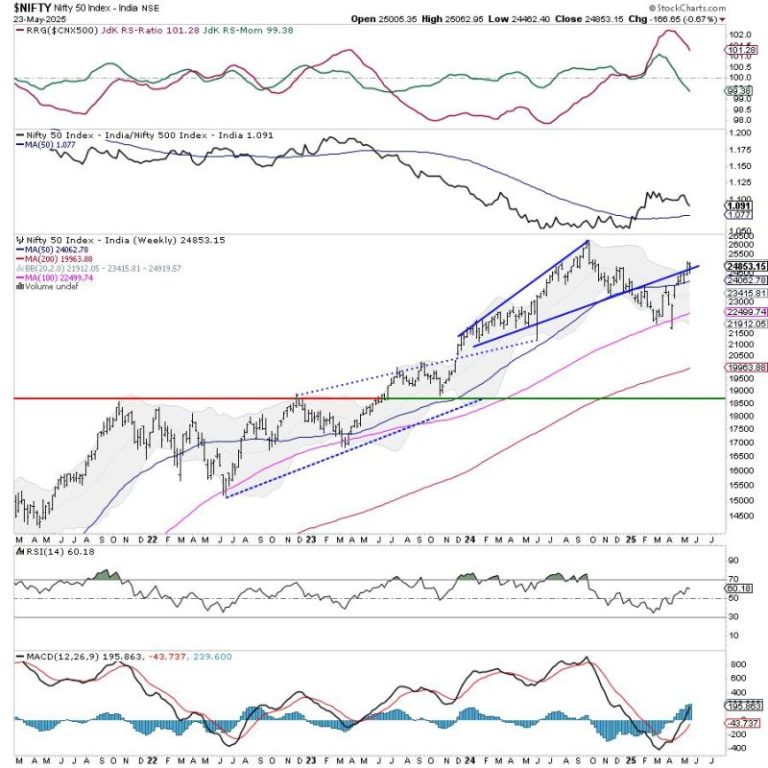
After a very strong move in the week before this one, the markets chose to take a breather. They moved in a wide range but ended the week on a mildly negative note after rebounding from their low point of the week. While defending the key levels, the markets largely chose to stay within a defined range. The trading range remained reasonably wide; the Nifty oscillated in a 600.55-point range over the past five sessions. The volatility inched modestly higher; the India Vix rose 4.40% to 17.28 on a weekly basis. While keeping its head above crucial levels, the headline index closed with a net weekly loss of 166.65 points (-0.67).
The coming week will be an expiry week; we will have monthly derivatives expiry playing out as well. Going by the options data, the Nifty has created a trading range between 25100 and 24500 levels. The markets are likely to consolidate in this 600-point trading range. A directional bias would emerge only if the Nifty takes out 25100 on the upside convincingly or ends up violating the 24500 level. While the underlying trend stays intact, the markets are unlikely to develop any sustainable trend so long as they do not move past the 25100 level. While the markets stay in the defined range, it would be prudent to vigilantly guard profits at higher levels and rotate sectors effectively to remain invested in the relatively stronger pockets.
The weekly RSI is at 60.14; it stays neutral and does not show any divergence against the price. The weekly MACD is bullish and stays above its signal line.
The pattern analysis shows that the Nifty has formed a trading range between 25100 on the higher side and 24500 on the lower side. This means that a directional bias would emerge only if Nifty moves past 25100 convincingly or violates the 24500 level. Until either of these two things happens, we will see the Nifty consolidating in this defined range. The Nifty has so far defended the pattern support level that also exists in the 24400-24500 zone.
Overall, the markets continue to remain in a challenging environment and face strong resistance near the 25100 level. So long as the Nifty stays below this level, it stays prone to corrective spikes, which may also keep volatility at slightly elevated levels as well. Given the current technical structure, it would be imperative that not only the sectors be rotated properly to stay invested in relatively stronger pockets, but all existing gains must also be vigilantly guarded at current levels by the investors. While continuing to keep leveraged exposures at modest levels, a cautious outlook is advised for the coming week.
In our look at Relative Rotation Graphs®, we compared various sectors against the CNX500 (NIFTY 500 Index), representing over 95% of the free-float market cap of all the listed stocks.
Relative Rotation Graphs (RRG) show that while the Nifty Consumption, PSU Bank, Infrastructure, Banknifty, FMCG, and Commodities indices are in the leading quadrant, all are showing a distinct slowdown in their relative momentum against the broader Nifty 500 Index. While these groups are likely to show resilience and may relatively outperform, except for the Consumption Index, they are giving up in favor of other sectors that are showing renewed relative strength.
The Nifty Financial Services Index has rolled inside the weakening quadrant. The Nifty Metal and Services Sector Indices are also inside the weakening quadrant.
While the Nifty Pharma Index continues to languish inside the lagging quadrant, the IT Index, which is also inside the lagging quadrant, is showing sharp improvement in its relative momentum against the broader markets.
The Nifty Realty, Auto, Midcap 100, and Energy Sector Indices are inside the improving quadrant. These groups are expected to continue bettering their relative performance against the broader markets.
Important Note: RRG charts show the relative strength and momentum of a group of stocks. In the above Chart, they show relative performance against NIFTY500 Index (Broader Markets) and should not be used directly as buy or sell signals.
Milan Vaishnav, CMT, MSTA
Consulting Technical Analyst
www.EquityResearch.asia | www.ChartWizard.ae

The once-solid relationship between President Donald Trump and Apple CEO Tim Cook is breaking down over the idea of a U.S.-made iPhone.
Last week, Trump said he “had a little problem with Tim Cook,” and on Friday, he threatened to slap a 25% tariff on iPhones in a social media post.
Trump is upset with Apple’s plan to source the majority of iPhones sold in the U.S. from its factory partners in India, instead of China. Cook confirmed this plan earlier this month during earnings discussions.
Trump wants Apple to build iPhones for the U.S. market in the U.S. and has continued to pressure the company and Cook.
“I have long ago informed Tim Cook of Apple that I expect their iPhone’s that will be sold in the United States of America will be manufactured and built in the United States, not India, or anyplace else,” Trump posted on Truth Social on Friday.
Analysts said it would probably make more sense for Apple to eat the cost rather than move production stateside.
“In terms of profitability, it’s way better for Apple to take the hit of a 25% tariff on iPhones sold in the US market than to move iPhone assembly lines back to US,” Apple supply chain analyst Ming-Chi Kuo wrote on X.
UBS analyst David Vogt said that the potential 25% tariffs were a “jarring headline” but that they would only be a “modest headwind” to Apple’s earnings, dropping annual earnings by 51 cents per share, versus a prior expectation of 34 cents per share under the current tariff landscape.
Experts have long held that a U.S.-made iPhone is impossible at worst and highly expensive at best.
Analysts have said that iPhones made in the U.S. would be much more expensive, CNBC previously reported, with some estimates ranging between $1,500 and $3,500 to buy one at retail. Labor costs would certainly rise.
But it would also be logistically complicated.
Supply chains and factories take years to build out, including installing equipment and staffing up. Parts that Apple imported to the United States for assembly might be subject to tariffs as well.
Apple started manufacturing iPhones in India in 2017 but it was only in recent years that the region was capable of building Apple’s latest devices.
“We believe the concept of Apple producing iPhones in the US is a fairy tale that is not feasible,” wrote Wedbush analyst Dan Ives in a note on Friday.
Other analysts were wary about predicting how Trump’s threat ultimately plays out. Apple might be able to strike a deal with the administration — despite the eroding relationship — or challenge the tariffs in court.
For now, most of Apple’s most important products are exempt from tariffs after Trump gave phones and computers a tariff waiver — even from China — in April, but Apple doesn’t know how the Trump administration’s tariffs will ultimately play out beyond June.
“We’re skeptical” that the 25% tariff will materialize, wrote Wells Fargo analyst Aaron Rakers.
He wrote that Apple could try to preserve its roughly 41% gross margin on iPhones by raising prices in the U.S. by between $100 and $300 per phone.
It’s unclear how Trump intends to target Apple’s India-made iPhones. Rakers wrote that the administration could put specific tariffs on phone imports from India.
Apple’s operations in India continue to expand.
Foxconn, which assembles iPhones for Apple, is building a new $1.5 billion factory in India that could do some iPhone production, the Financial Times reported Thursday.
Apple declined to comment on Trump’s post.

The local French authority for
the Alpes-Maritimes region said on Saturday that part of the
area was suffering a major electricity outage, including the
town of Cannes which is currently hosting its annual film
festival.
This is a developing story and will be updated.

After 19 months of pounding Gaza, Israel is now under growing pressure from unlikely quarters – some of its closest Western allies.
Their patience has worn thin over Israel’s decision to expand the war and, in the words of one Israeli minister, “conquer” the territory – a move paired with plans to forcibly displace Gaza’s entire population to the south and block all humanitarian aid for 11 weeks.
The United Kingdom has paused trade talks and sanctioned extremist settlers in the West Bank. Canada and France have threatened sanctions. And the European Union – Israel’s biggest trade partner – is reviewing its landmark Association Agreement with the country.
Aid groups have warned that the situation in Gaza is becoming catastrophic, with the United Nations’ humanitarian chief Tom Fletcher last week calling on the world to “act decisively to prevent genocide.”
Dozens of babies have died of malnutrition, according to Gaza’s health ministry, and more than 53,000 people – or 4% of the entire population – have been killed since Israel launched its war following the October 7 terror attacks by Hamas and its allies.
The fact that some of Israel’s closest allies are now pushing back more vocally marks a major shift in attitudes toward the country.
The agreement, which covers various forms of cooperation between the two parties, including the free movement of goods and scientific collaboration, has been in place for 25 years. “The mere fact that this is being discussed seriously today is a sign of not just the increasing frustration, and I think also, let’s be quite clear, anger, in some European capitals over Israeli actions in Gaza,” said Lovatt.
The punitive steps threatened by the EU and other allies are designed in part to sway the domestic debate inside Israel, where society is already extremely divided over the war.
The government, propped up by hardliners from far-right parties, is determined to keep fighting in Gaza. But hundreds of thousands of Israelis demonstrate against the war each week, demanding the government agrees a ceasefire deal to release all the hostages still held in the strip.
In an opinion poll published by Israel’s Channel 12 broadcaster earlier this month, 61% of those surveyed favored ending the war for a deal that secures the hostage release, while only 25% supported the expanded military operation.
That notwithstanding, Arie Reich, a legal scholar at Israel’s Bar-Ilan University who specializes in international trade and EU law, said that external pressure on Netanyahu’s government may not have the desired effect.
“When foreign countries try to interfere in internal matters of another country, especially things that are very dear to them, such as their national security, it usually works as a boomerang, and it actually causes the people to support the government even more,” he said.
“There is a wide consensus in Israel that we want to release our hostages, and that we do not want to go back to where we were on October 6. We don’t want to have this threat of Hamas lingering over us,” Reich said.
But he added that the moves by some of Israel’s allies have made it clear that the “window of using military force is starting to close.”
“And maybe, if it goes on longer than that, I think it’s going to be very hard to maintain normal relations with many countries in the West,” he said.
Israel has so far brushed aside the threats from its Western allies. Prime Minister Benjamin Netanyahu has accused them of “offering a huge prize” to the October 7 attackers, while Israel’s foreign ministry said that “external pressure will not divert Israel from its path in the fight for its existence and security against enemies seeking its destruction.”
This determination to continue may be due to Netanyahu believing that he can, for now at least, rely on the United States for support.
And while the moves are diplomatically symbolic, critics expect little to change on the ground for Palestinians.
Short of a total arms embargo and a full suspension of economic relations, Israel is unlikely to change its ways, he said, arguing that Canada, France and the UK had been “complicit” in Israel’s actions in Gaza by providing it with “military, intelligence, economic, and diplomatic support.”
All three countries have longstanding agreements with Israel that include defense and security cooperation, although the detail of what exactly these contain is unclear.
The UK and France have suspended some arms licenses to Israel over the situation in Gaza but have continued to export military equipment worth tens of millions of dollars to Israel. Canada has said that no export permits on military goods to Israel have been issued since January 8, 2024.
As Israel’s most powerful ally, the US has the most sway over Netanyahu and his government. And while some in the Trump administration have criticized Israel over the dire humanitarian situation in Gaza, there has been no indication the US would take any punitive actions against it.
It isn’t, however, a “foregone conclusion that the US will continue to always unequivocally back Israel,” Lovatt said.
“While I don’t see a rupture in relations, clearly, the arrival of the second Trump administration has created an interesting dynamic, given the influence of what I would call the ‘America Firsters,’ those in the MAGA world who want to put the US first in everything, and that has, to a certain extent, also applied to Israel,” he said.
The US has moved out of step with Israel on number of issues in recent weeks.
It has struck a ceasefire deal with Yemen’s Iran-backed Houthi rebels without first informing Israel; unilaterally negotiated with Hamas the release of US citizen Edan Alexander from Gaza; and, according to a Reuters report, has dropped its demand for Saudi Arabia to normalize relations with Israel as a condition for US investment and potential US arms deals.
Addressing Israel’s criticism over the deal with the Houthis, US ambassador to Israel Mike Huckabee told Israeli media that the US “isn’t required to get permission from Israel” to get an agreement that protects its ships.
“Netanyahu has positioned himself as a master of the US political game, and as someone who’s best placed to manage and maintain tight Israel relations and to keep any US presidential administration on side. I think seeing some daylight between the Trump administration and the Israeli government clearly puts pressure on Netanyahu,” Lovatt said.
There are signs that some in Israel are worried about the consequences of its actions in Gaza. The leader of Israel’s opposition left-wing Democrats party, retired Israeli general Yair Golan, warned on Tuesday that Israel is “on its way to becoming a pariah state.”
The impact of the pressure from the allies was on display on Sunday, when the Israeli military announced it would allow a “basic amount of food” to enter Gaza as it launched its new offensive in the strip, which Israel says is intended to pressure Hamas to release the hostages held there.
Netanyahu conceded on Monday that if “a situation of famine” arose in Gaza, Israel “simply won’t receive international support.”
In a statement posted to Telegram, he added that even US senators “who have been staunch, unconditional supporters of Israel for decades” had told him that “images of mass starvation” in Gaza would cost Israel their support.
Even if the US won’t use its leverage to force Israel to change its strategy in Gaza in a more significant way, it doesn’t mean Europe can’t put pressure on Israel on its own, experts say.
The European Union is Israel’s biggest trading partner, accounting for roughly a third of its trade in goods.
A full suspension of the Association Agreement between the EU and Israel is unlikely, as it would require unanimous agreement of all 27 EU member states and several have already indicated they would not support it – including Hungary, a staunch supporter of Israel.
Reich said that under the terms of the agreement, both the EU and Israel can terminate it for whatever reason, or even without giving a reason.
“The thing is that within the EU, that would require consensus … and that would be very, very hard, because there are many countries, many (EU) member states that will not go along with this,” he said.
“So I think it’s more of a threat to put pressure (on Israel) and maybe they could manage some temporary suspension of some provisions, but to terminate it, I don’t think it can happen,” he added.
Public support for the country runs deep in many of the bloc’s member states, which makes it difficult for some European governments to push for harsher sanctions against Israel.
And, Lovatt said, many European countries are also aware of the fact that they may need Israel’s help in the future.
“Especially in a situation where European countries are increasingly fearful of Russia’s actions in Ukraine, but also the threat that Russia represents the rest of Europe, and (they) see Israel as an important source of weapons and technology,” he said.
While terminating the association agreement would require unanimity, it would only take a majority of EU states to force through a partial suspension of the agreement.
Even that could be painful for Israel because it could lead to higher tariffs on Israeli products or prevent Israel from taking part in coveted EU projects such as the Horizon Europe program, with more than $100 billion in funding available for research and innovation.
The EU has in the past used its power to put pressure on countries over human rights abuses – often for issues Lovatt says are a lot less serious than the current situation in Gaza.
“The bottom line is that until now, the EU has treated Israel with a degree of exceptionalism by not taking anywhere near the sort of steps that it has taken in other situations of human rights abuses or territorial annexation,” Lovatt said.

This week, while everyone else is focused on NVIDIA Corp. (NVDA), we will focus our attention on stocks with earnings that may get overlooked.
We’re watching a different group of stocks heading into earnings: Okta, Inc. (OKTA), AutoZone, Inc. (AZO), and Salesforce.com, Inc. (CRM). OKTA and AZO are making new highs as they head into their earnings call, while CRM is struggling.
Let’s break down the best risk/reward set-ups as we kick off the week.
Okta’s stock price broke out to new 52-week highs a week before it posts its quarterly numbers. The cybersecurity company has experienced extreme volatility after posting earnings. In the last three quarters, the stock saw some pretty big swings—up 24.3%, up 5.4%, and down 17.6%. Its average price change post-earnings is +/-10.2%.
Technically, I love this setup. Let’s look at a five-year daily chart.
Shares have broken out ahead of earnings and have a lot to reverse. If we see weakness after results, there are several support areas where we would want to enter the stock with favorable risk/reward. The first strong support area is between $115/$118, an old resistance level that the stock just eclipsed. Old resistance could act as new support and provide an opportunity.
Outside of recent weakness due to “Liberation Day,” OKTA’s stock price has outperformed its peers and held key moving averages. Use levels just below the 50-day moving average around $110 as a near-term stop if $115 doesn’t hold.
To the upside, there is much to reverse and targets of $150 to $160 are attainable. If you’re a longer-term investor, the downtrend is broken and the bulls are back in charge.
The retail leader in automotive replacement parts and accessories, AutoZone, Inc. (AZO), continues to rise, slowly and steadily, despite market volatility. The stock price is up 20% year-to-date, and we hope to add to those gains when they report on Tuesday morning.
One thing that has helped AZO’s continued growth is that the average car is roughly 12 years old. Consumers are investing more in maintenance and repairs instead of purchasing new vehicles. And with tariffs, buying a new car becomes more expensive, which benefits the car repair and maintenance business.
Let’s look at that long-term uptrend on a weekly chart going back five years.
The stock is a juggernaut. It has ridden the 50-week moving average consistently since Covid. It is in a beautiful uptrend and made new highs again just last week.
While the trend itself appears a tad extended above its averages, any trip back towards its recent uptrend line gives investors a strong entry point, with downside risk towards its 50-week moving average.
It’s also the best in class when compared to its top competitors, such as O’Reilly Automotive (ORLY) and Advanced Auto Parts (AAP). When looking at strong uptrends in a challenging environment, it’s best to find the best in class, and AZO continues to be just that. The trend continues to be the investor’s best friend.
A year ago, Salesforce (CRM) shocked investors with a revenue miss for the first time since 2006. This resulted in the stock price dropping 20% (red box in the chart below). It marked the stock’s low point, as it rallied as much as 74% over the next seven months. It now sits in the middle of a wide year-long range and is poised to move again.
Which way will it go? To examine that question, let’s look at the daily chart of CRM.
Technically, shares are at a crossroads. Shares dropped 37% from their December peak after forming a double top. It just broke its near-term downtrend from its post-Liberation Day lows, experiencing a 28% rally, but paused right at its 200-day moving average.
Momentum appears to be negative. The Moving Average Convergence/Divergence (MACD) has formed a bearish crossover, and shares failed to eclipse the 200-day. Shares are down -18% for 2025, underperforming the tech sector and the S&P 500. CRM sold off late Friday, hitting its 50-day moving average, on news that it’s in talks to acquire Informatica.
If you’re thinking of buying CRM, you may want to hold your horses. Watch the 50-day moving average around $270 to see if it can hold. On strength, look for confirmation and a close above the $295 level for an all clear that momentum has finally shifted in favor of the bulls.
OKTA, AZO, and CRM are thoughtful plays based on technical trends and real-world fundamentals. OKTA and AZO could have favorable risk/reward setups. As for CRM, add it to your ChartLists and monitor it regularly.

It scares me to admit I’ve been investing for over 50 years. It’s been a great ride, and fortunately I’m still going strong. One of my investment mantras thru all these years has been Charlie Munger’s quintessential advice: “try to be consistently not stupid.”
We all make investing mistakes, but not all of us learn the appropriate lessons from those mistakes. This blog is less about mistakes and more about lessons. If the investment genie were to offer me a redo on my portfolio management execution from these past decades, here are seven things I would do differently next time around.
Trade well; trade with discipline!
StockMarketMastery.com
P.S. If you would like to be notified when I post a new Traders Journal blog, please submit your preference via the tile in the right column titled FOLLOW THIS BLOG.