Author

admin

Browsing

Prime Minister Benjamin Netanyahu kept up appearances for nearly 19 months: Freeing the hostages and defeating Hamas, he insisted, stood equally atop the pyramid of Israel’s war goals.

Even as members of his right-wing governing coalition threatened to topple his government if he agreed to a ceasefire and hostage release deal. Even as he himself threw up eleventh-hour obstacles to reaching such a deal. And even as evidence mounted that Israel’s military operations had both directly and indirectly led to the killing of Israeli hostages. Amid all those contradictions, Netanyahu insisted both objectives were just as important.

But not anymore. Now, Netanyahu is unabashedly prioritizing war – and the survival of his government – over the fate of 59 hostages still in Gaza and the will of most Israelis.

A week after calling the defeat of Israel’s enemies the “supreme objective” of the war, Netanyahu is turning that rhetoric into action: calling up tens of thousands of reservists to pummel, seize and occupy large swaths of Gaza – what the prime minister calls the “final moves” against Hamas.

Israeli officials say the plan won’t be implemented immediately, giving Hamas at least another week-and-a-half to agree to another limited hostage and ceasefire deal on Israel’s terms – with some insisting that is the government’s preference. The deadline, they say, is the conclusion of US President Donald Trump’s visit to the region next week. But such a deal is unlikely to materialize in that timeframe and these are no longer idle threats.

The right-wing ministers who have sabotaged previous ceasefire deals and long called for conquering Gaza are now celebrating, viewing the newly approved plans as the first step toward their vision of occupying and ultimately annexing the enclave. Finance Minister Bezalel Smotrich now vows that there will be “no retreat from the territories we have conquered, not even in exchange for the hostages.”

For Netanyahu, that means political security – taking Smotrich and National Security Minister Itamar Ben Gvir’s repeated threats to leave the government and force new elections off the table, keeping him in the prime minister’s office.

It also means going against the will of a clear majority of Israelis – 56% according to Israel’s Kan 11 and 69% according to Channel 12 – who support a deal to end the war in exchange for the release of all remaining hostages.

Hamas has repeatedly said it is open to such an all-in-one deal, hoping to salvage its position of power in Gaza, but the Israeli government has rejected any end to the war that leaves the group armed and governing the strip.

For the families of Israeli hostages, Netanyahu’s decision has been a gut punch, one they fear won’t just delay the return of their loved ones but actively endanger them.

“It seems the government has placed defeating Hamas above rescuing and returning the hostages, because doing so would require stopping the war,” Anat Angrest, the mother of captive Israeli soldier Matan Angrest, told Haaretz. “Ministers are sending soldiers into harm’s way and putting the hostages at further risk, when all that was needed was a pause to develop a real strategic plan. What’s happening now is a war fueled by revenge and conquest, not by a genuine desire to save lives.”

“It doesn’t reflect the will of the people, or the Jewish heart,” she said.

The expanded Israeli assault in Gaza won’t just bring the risk to the hostages of more Israeli bombs. Hamas has repeatedly said it will execute hostages if Israeli forces close in on their positions, a threat it carried out last August in murdering six of them. Israel’s plan to displace nearly all of Gaza’s population to its southern part while continuing to starve the rest of the strip of humanitarian aid could also endanger the hostages’ access to the already limited food they are given.

For the people of Gaza, Netanyahu’s decision threatens catastrophe beyond the dire humanitarian crisis already gripping the besieged territory. The expanded Israeli assault guarantees another mass forced displacement of Palestinians, more death and destruction and the continued use of starvation as a weapon of war.

Even as Netanyahu’s decision to prioritize destroying Hamas over the fate of the remaining hostages becomes clear, the Israeli military’s ability to achieve its aims vis-à-vis the group remain uncertain.

The factors that have allowed Hamas to survive and stay in power in Gaza after nearly 19 months of war still remain, and Israeli national security analysts remain skeptical that tens of thousands of additional troops will fundamentally change the dynamics of the conflict. Sending them with the goal of occupying large swaths of Gaza could drive up Israeli military casualties, with the risk of bogging the military down for years in a counterinsurgency morass.

Perhaps that is why Netanyahu did not barrel headfirst down the path he has now chosen.

Trump’s return to power allowed Netanyahu to shed the guardrails imposed on him by President Joe Biden during the first 15 months of the war. But even as Trump and his administration made clear they would not seek to constrain Israel’s military actions in Gaza, Netanyahu did not immediately pursue the expanded war his right-wing allies have been clamoring for.

But in a fulcrum moment, he has now chosen – a decision that will shake the Gaza Strip, forever altering the fate of more than 2 million Palestinians and 59 hostages.


This post appeared first on cnn.com

Riches are found in reactions—your reactions to changes in the markets. By this, I mean that if you spot a change in money flowing from one asset class to another, one sector to another, one industry to another, before the masses notice, you will be rewarded handsomely. My experience has been that your profits will accumulate dramatically and consistently.

A fine example of this principle in the corporate arena is the global footwear and accessories retailer, Aldo. The company has 1,600 stores in 80 countries and is immensely profitable. Their secret sauce: quick reactions to market trends. When they identify a change in fashion trends, they’re 50 percent quicker than their competition in designing, producing and delivering the hottest styles. Yes, fifty percent faster, and that’s gold to their bottom line.

This can be your secret sauce to investment profits as well. Your personal portfolio of ChartLists is the equivalent of Aldo’s design department, production department, and delivery department all bundled together. It facilitates quick reactions to current observable stock market opportunities.

In simplistic terms, your personal collection of ChartLists is like giving a runner a bicycle or giving a Jeep driver a Porsche. ROI (return on investment of your time and efforts) becomes supercharged. Your ChartLists allow you to become a “force of consistency.” They will also help you embrace one of Charlie Munger’s key investment tenets, “Try to be consistently not stupid.”

To achieve this end, I humbly suggest that you could best start with the Stock Market Mastery ChartPack.

Assembling your portfolio of ChartLists is analogous to building your custom dream house. There are sensational books of checklists that systematically ask you a comprehensive series of questions and bring up features you should consider. The end result should be a custom home you love, that fits you perfectly, and that accommodates your unique lifestyle. Think of the Stock Market Mastery ChartPack, then, as an extensive checklist—a buffet of pre-populated and organized ChartLists, from which you build your own custom collection of ChartLists that fits your investing methodology perfectly and facilitates your personal Investor Self. These 80 ChartLists are carefully structured, all pre-populated with expertly designed charts and a carefully-crafted organization to maximize your precious time and insights. Indeed, nearly all the informational breadcrumbs the market has to offer will be made clear to you and offer you a profitable trail to follow. Your reflexes and reactions just got supercharged. It is that easy.

Trade well; trade with discipline!

Gatis Roze, MBA, CMT

StockMarketMastery.com

  • Author, “Tensile Trading: The 10 Essential Stages of Stock Market Mastery” (Wiley, 2016)
  • Developer of the “Stock Market Mastery” ChartPack for StockCharts members
  • Presenter of the best-selling “Tensile Trading” DVD seminar
  • Presenter of the “How to Master Your Asset Allocation Profile DVD” seminar

Families of October 7 hostages held in Gaza demanded any new information from the Israeli government after US President Donald Trump said three more captives had died.

“As of today, it’s 21. Three have died. So, this is a terrible situation,” Trump said on Tuesday.

The remark was a shock to the families of the hostages.

“We demand once again from the Israeli government – if there is new information that has been hidden from us, pass it on to us immediately,” the Hostages and Missing Families Forum said on Wednesday.

“The headquarters once again calls on the Prime Minister to stop the war until the last abductee is returned. This is the most urgent and important national task.”

Israel’s public and official position, reiterated on Tuesday by Israel’s Coordinator for the Captives and the Missing Gal Hirsch, is that 24 hostages are alive. “The Hamas terror organization is currently holding 59 hostages,” Hirsch said on social media several hours after Trump’s comments. “24 of them are on the list of living hostages.”

But there have been clear indications that Israel has reason to believe the true number is fewer, even beyond Trump’s comments.

On Wednesday, Prime Minister Benjamin Netanyahu published a video statement in which he made the clearest acknowledgement, yet that Israel believes not all 24 are alive.

“We know for certain that there are 21 alive. There’s no argument about this. There’s three where there is doubt about whether they are alive,” he said in the prerecorded video. “We’re not giving up on anyone.”

Earlier this week, Netanyahu approved an expansion of the war in Gaza and a plan to force the Palestinian population into a shrinking tract of land in the southern part of the besieged territory. Israel says its military operations are intended to put pressure on Hamas to make a ceasefire agreement, but prospects for an imminent deal are quickly dwindling, and with them the hope of bringing the remaining hostages out soon.

Even before the latest video statement, Netanyahu has recently been careful to say that “up to 24” hostages are being held alive in Gaza.

Last week, when Netanyahu said there were “up to 24” living, his wife, Sara, interrupted him and said: “Fewer.”

The open mic moment sparked its own outcry from the families of the hostages. “If the wife of the prime minister has new information about the kidnapped who were killed, I demand from her to know if my Matan is still alive, or if he was murdered in captivity because your husband refuses to finish the war,” Einav Zangauker, the mother of one of the hostages, said on social media.

Israeli officials have said there are “grave concerns” about three of the hostages but would not say whether Israel knows for certain that they are dead.

Trump’s comments strongly suggest otherwise and appear to indicate that Israel has shared sensitive information about the condition of the hostages with the Trump administration.

More than 250 people were taken hostage when Hamas militants launched a surprise attack on Israel on October 7, 2023 – sparking the ongoing war in Gaza.

This post appeared first on cnn.com

Valerie the dachshund has finally been reunited with her owners after surviving 540 days alone on Kangaroo Island in South Australia.

Owners Georgia Gardner and Josh Fishlock described the moment they got to hold the tiny pup in their arms in a statement published Wednesday.

Gardner said she “burst into tears” when Valerie ran up to her as they saw each other again for the first time on Tuesday.

“She was wagging her tail, making her little happy sounds, and wiggling around with joy. I held her and cried and cried,” she said in the statement.

“She’s stockier now, strong and healthy… healthier than we are, honestly!” added Gardner.

Fishlock said the pair hadn’t expected to see Valerie again.

“It still doesn’t feel real,” he said in the statement.

Valerie, who will soon celebrate her third birthday, went missing on a camping trip to the island in November 2023.

When strangers tried to help, she fled into the undergrowth, and her owners eventually gave up and returned home to the mainland.

With no sightings it was assumed Valerie had met her match with a snake or perhaps one of the giant Rosenberg’s goannas — reptiles up to 1.5 meters (5 feet) long — that occupy the island.

However, reports of sightings started to emerge, sparking a massive search operation led by volunteers from the Kangala Wildlife Rescue, a non-profit group set up in 2020 following the devastating Australian bushfires.

Valerie was eventually found on April 25, and has been looked after by the charity since.

Director Jared Karran described Valerie as “truly something special.”

“She was just so much smaller than we imagined. If it was a miracle before that she’d survived — seeing her size — it’s just unbelievable that she was able to survive and thrive out there!” he said in the statement.

Home to around 5,000 people, Kangaroo Island is about 45 minutes from the mainland by ferry. Tourists go there to see Australian native wildlife, but officials have long had a problem controlling introduced species including feral cats. The island is thick with bush, and there are many places for a small dog to hide.

Another difficulty is the island’s vibrant ecosystem, according to the charity.

“One of the reasons this is such a difficult rescue and not as easy as just baiting and setting traps, is due to the fact we are constantly competing with hundreds of wildlife like possums, wallabies, kangaroos, goannas and feral cats. All which are all just after a feed also,” the group said in a post on Facebook before the little dog was found.

Now Valerie is preparing to return home to Albury, New South Wales, where she will be reunited with Gardner and Fishlock’s other pets, Lucy the rescue cat, Mason the red heeler and their latest addition, Dorothy, a fellow dachshund.

This post appeared first on cnn.com

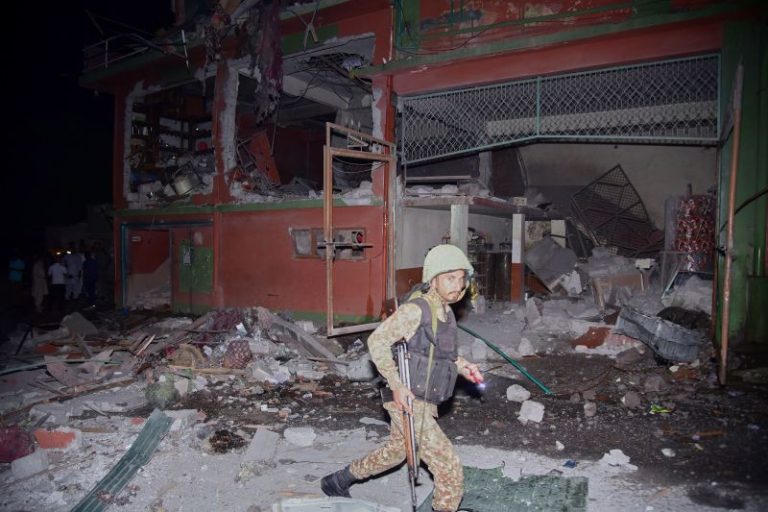
India launched military strikes on Pakistan on Wednesday and Pakistan claimed it shot down five Indian Air Force jets, in an escalation that has pushed the two nations to the brink of war.

The escalation puts India and Pakistan, two neighbors with a long history of conflict, in dangerous territory, with Islamabad vowing to retaliate against India’s strikes and the international community calling for restraint.

New Delhi said the strikes are in response to the massacre of 26 people – mostly Indian tourists – who died in April when gunmen stormed a scenic mountain spot in the India-administered part of Kashmir, a disputed border region. India has blamed Pakistan for the attack, which Islamabad denies.

Here’s what we know so far.

What happened with India’s strikes?

India launched “Operation Sindoor” in the early hours of Wednesday morning local time (Tuesday night ET) in both Pakistan and Pakistan-administered Kashmir.

Indian officials said nine sites were targeted, but claimed no Pakistani civilian, economic or military sites were struck. They said the 25-minute operation targeted “terrorist infrastructure” belonging to two militant groups – Lashkar-e-Tayyiba and Jaish-e-Mohammed.

The name ‘Sindoor’ appears to be a reference to the red vermilion, or powder, many Hindu women wear on their foreheads after marriage. The April tourist massacre – which singled out men as victims – left several Indian women widowed.

A Pakistani military spokesperson said six locations were hit with 24 strikes. Some of those strikes hit the densely populated province of Punjab, Pakistan’s military said, and were the deepest India has struck inside Pakistan since 1971, when the two countries fought one of their four wars.

How did Pakistan respond?

Pakistani security sources claimed they had shot down five Indian Air Force jets and one drone during India’s attack.

They did not say exactly where, or how, the jets were downed – but said three Rafale jets were among those planes. India’s Rafale fighter jets are prized military assets that it bought from France only a few years ago.

An eyewitness and local government official said an unidentified aircraft crashed in the village of Wuyan in Indian-administered Kashmir. Photos published by the AFP news agency showed aircraft wreckage lying in a field next to a red-brick building.

It was not immediately clear from the photos who the aircraft belonged to.

Pakistani Prime Minister Shehbaz Sharif said on Wednesday the country “has every right” to respond, calling India’s actions an “act of war.”

How many casualties are there?

At least 26 civilians were killed and 46 injured by India’s strikes, a Pakistan military spokesperson said, according to the news agency Reuters.

Lt. Gen. Ahmed Sharif Chaudhry, a spokesperson for Pakistan’s military, said those killed include teenagers and children – the youngest of whom was three years old.

Seven civilians in Indian-administered Kashmir were also killed by shelling by Pakistani troops from across the border, Reuters reported, citing police there.

What else is happening on the ground?

On Wednesday, the two sides also exchanged shelling and gunfire across the Line of Control (LOC), the de facto border that divides Kashmir.

Authorities in Indian-administered Kashmir have ordered citizens to evacuate from areas deemed dangerous, saying accommodation, food and medicine will be provided.

The strikes have disrupted flights, with Pakistan closing parts of its airspace. Multiple major international airlines are avoiding flying over Pakistan, while several Indian airlines have reported disrupted flights and closed airports in the country’s north.

Some context: There have been regular exchanges of gunfire along the Line of Control in the weeks following the Pahalgam massacre.

What prompted all of this? What is Kashmir?

Muslim-majority Kashmir has been a flashpoint in India-Pakistan relations since both countries gained their independence from Britain in 1947.

The two nations to emerge from the bloody partition of British India – Hindu-majority India and Muslim-majority Pakistan – both claim Kashmir in full and, months after becoming independent, fought their first of three wars over the territory.

The divided region is now one of the most militarized places in the world.

India has long accused Pakistan of harboring militant groups there that conduct attacks across the border, something Islamabad has long denied.

The massacre in the tourist hotspot of Pahalgam in April sparked widespread anger in India, putting heavy pressure on the Hindu-nationalist government of Prime Minister Narendra Modi.

India immediately blamed Islamabad, sparking tit-for-tat retaliatory measures in which both countries downgraded ties, canceled visas for each other’s citizens, and saw India pull out of a key water-sharing treaty.

What could come next?

The three previous wars over Kashmir have each been bloody; the last one in 1999 killed more than a thousand Pakistani troops, by the most conservative estimates.

In the decades since, militant groups have fought Indian security forces, with violence killing tens of thousands. The two countries have clashed multiple times, most recently in 2019 when India conducted airstrikes in Pakistan after it blamed Islamabad for a suicide car bomb attack in the region.

But those recent clashes did not explode into all-out war. Both sides are aware of the risks; since 1999, the two countries have worked to strengthen their militaries, including arming themselves with nuclear weapons.

How is the world reacting?

The strikes have raised global alarm and pleas for the two nations to prevent further escalation.

United Nations Secretary-General António Guterres voiced “deep concern” over India’s strikes, warning that the world “cannot afford a military confrontation” between the two nations.

The United States – which had urged restraint from both countries last week – said it was “closely monitoring developments,” according to a State Department spokesperson.

“We are aware of the reports, however we have no assessment to offer at this time,” the spokesperson said Tuesday. “This remains an evolving situation, and we are closely monitoring developments.”

The United Arab Emirates, China and Japan have also called for both sides to de-escalate.

This post appeared first on cnn.com

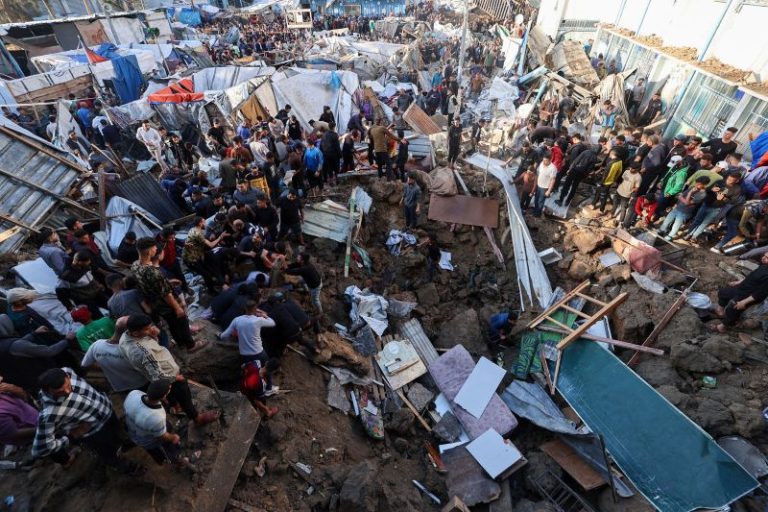
At least 22 people, including seven children, were killed Tuesday in an Israeli strike on a school compound sheltering thousands of displaced people in the Al Bureij camp in central Gaza, hospital officials said.

Dozens more were injured in the strike, they said.

At the site of the attack, video from the scene showed a large crater where people searched through the rubble of the school for survivors, the remnants of tents and belongings littering the ground.

Safaa Al Khaldi, who was sheltering at the school, said that her son was injured in the strike.

“Our children are starving, our children cannot find a piece of bread,” she said, referring to Israel’s complete blockade of Gaza, now in its third month. “What did we do wrong?”

The Israel Defense Forces (IDF) said it struck “terrorists who were operating within a Hamas command and control center,” on Tuesday, but did not provide any further information about the strike.

At the school compound, one woman screamed at Hamas, an expression of anger at Gaza’s ruling militants once virtually unthinkable. “Hamas should get out of the school, they are hiding between the people,” she cried. “Get them out, what’s the fault of the children who are torn apart?”

Tuesday’s strike on the refugee camp comes less than 24 hours after Israeli Prime Minister Benjamin Netanyahu said the population of Gaza will be displaced to the south after his security cabinet approved an expanded military operation in the enclave.

“There will be a movement of the population to protect them,” Netanyahu said of the “intensified operation,” which by one far-right minister said would be a plan to “conquer” the besieged territory.

Since the Israeli cabinet approved an expanded military operation in Gaza on Sunday, at least 48 Palestinians have been killed and another 142 injured, according to the Palestinian Ministry of Health. More than 2,500 Palestinians have been killed since Israel resumed its bombardment of Gaza on March 18, according to figures provided by the ministry.

On Monday, the Palestine Red Crescent Society said 13 of its 29 clinics in Gaza have shut down. The ones that are still functioning have “limited capabilities,” it said. Meanwhile, 21 out of Gaza’s 36 hospitals are only partially functioning, according to the UN health agency.

Israel’s blockade, which has prevented the entry of food and medicine, is pushing the Gaza’s ravaged healthcare system towards collapse, aid agencies have warned.

Near the site of the latest Israeli strike, a woman hugged her crying daughter, saying that all her daughter’s friends were killed.

“My friend Leen is gone, my friend Yousra is gone, my friend Miral is gone,” the daughter said as tears streamed down her face.

The UN’s humanitarian agency (OCHA) warned Tuesday of a “deepening catastrophe” in Gaza amid the blockade.

“OCHA stresses that under international humanitarian law, civilians must be protected, and their essential needs – including food, shelter, water and healthcare – must be met, wherever they are in Gaza and whether they move or stay,” OCHA said.

This post appeared first on cnn.com

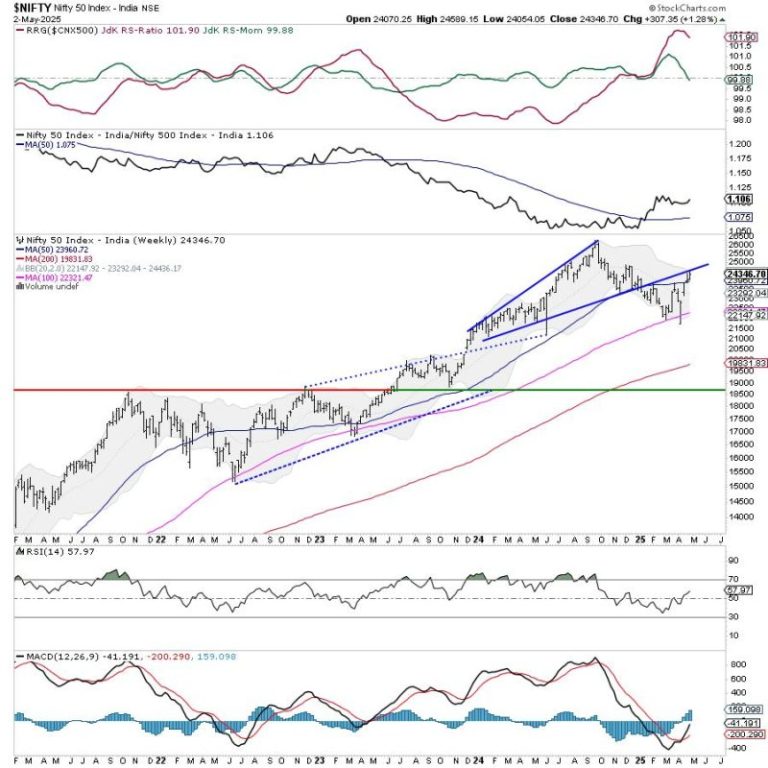
In the truncated week due to one trading holiday, the markets extended their gains and closed the week on a positive note. While remaining largely within a defined range, the Nifty continued consolidating above its 200-DMA while not adopting any sustainable directional bias. While the Index continued defending its key support levels, it oscillated in the range of 535.10 points. Volatility continued moving higher; the India Vix surged by 6.41% to 18.26 on a weekly basis. While staying positive, the headline index closed with a net weekly gain of 307.35 points (+1.28%).

From a technical standpoint, the Nifty has kept its underlying bias intact; it is currently consolidating above the 200-DMA positioned at 24050. The 50-week MA is placed at 23962. This makes the 24950-24050 a strong 200-point support zone for the Nifty for the coming weeks and the foreseeable short term. So long as the Index keeps it above this 200-point support zone, it will just consolidate and not show any major drawdowns. However, any violation of 24900 will increase the possibility of some corrective retracement. Watching Nifty’s behavior vis-à-vis the zone of 23950-24050 would be crucial over the coming days.

The geopolitical tensions between India and Pakistan remain ingrained in the market behavior; the rise in Vix shows increased hedging activity by the market participants. Monday is likely to see a stable start to the day; the levels of 24550 and 24780 are likely to act as resistance levels. The supports come in at 24050 and 23900. The trading range is expected to stay wider than usual.

The weekly RSI stands at 57.92. While the RSI has formed a fresh 14-period high, it remains neutral and does not show any divergence against the price. The weekly MACD is bullish and trades above its signal line.

The pattern analysis shows that on the daily chart, the Nifty crossed above the 200-DMA a few days ago; now, it is consolidating just above this important level. It has penetrated the 50-week MA placed at 23962, and this level is now expected to act as support in the event of any corrective retracement. Importantly, the Nifty has resisted the rising trendline pattern resistance near 24600. This trendline begins at 21130 levels and joins the subsequent rising bottoms.

The coming week will require a more cautious approach as the markets not only deal with key resistance levels but also with geopolitical tensions that remain embedded in the backdrop. The investors will need to move away from the stocks that have risen over the past weeks and move to those sectors and stocks that are readying for a fresh move. While focusing more on low-beta stocks, the leverage, too, needs to be curtailed. The Index has risen over 2500 points over the past three weeks, and if it consolidates a bit, it should not surprise the market participants. A highly cautious and stock-specific approach is advised for the coming week.


Sector Analysis for the coming week

In our look at Relative Rotation Graphs®, we compared various sectors against the CNX500 (NIFTY 500 Index), which represents over 95% of the free-float market cap of all the listed stocks.

Relative Rotation Graphs (RRG) show the Nifty FMCG index has rolled inside the leading quadrant. The PSU Bank, Infrastructure, and Consumption Index are also inside the leading quadrant. The Metal, Commodities, Financial Services, and Nifty Bank Index are also inside this quadrant, but they are giving up on their relative momentum. However, these groups may continue to outperform the broader markets relatively.

The Services Sector Index has rolled inside the weakening quadrant.

While the Nifty IT index continues to languish inside the lagging quadrant, the Midcap 100, Auto, Realty, and Pharma Indices are seen improving their relative momentum while being inside the lagging quadrant.

The Nifty Media, PSE, and Energy Indices are inside the improving quadrant; they are expected to better their relative performance against the broader markets.


Important Note: RRG charts show the relative strength and momentum of a group of stocks. In the above Chart, they show relative performance against NIFTY500 Index (Broader Markets) and should not be used directly as buy or sell signals.  


Milan Vaishnav, CMT, MSTA

Consulting Technical Analyst

www.EquityResearch.asia | www.ChartWizard.ae


The market does not always follow the same script or sequence, but bear markets typically end with a bottoming process marked by specific stages. These include capitulation, a short-term reversal-thrust, a follow-through thrust and long-term regime change. The first two stages mark downside excess and the initial turn around, while the latter two signal strong follow through. Today’s report will look at the first two phases, and preview the last two.

Phase 1: Capitulation

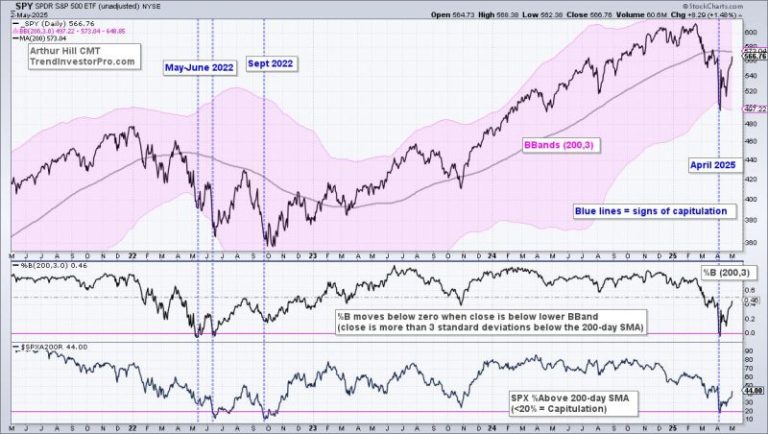
The capitulation phase of a bear market occurs when traders throw in the towel as downside momentum and selling pressure accelerate. Usually, the capitulation phase occurs after an extended decline, and this phase is the first step to a bottom. The chart below shows SPY with Bollinger Bands (200,3), %B (200,3) and S&P 500 Percent Above 200-day SMA ($SPXA200R). Signs of capitulation emerge when %B is below 0 and/or fewer than 20% of S&P 500 stocks are above their 200-day SMAs. The blue dashed lines show capitulation in June 2022, September 2022 and early April 2025. Note that we initially covered this capitulation phase in a report on April 8th.

Phase 2: Short-term Thrust Signals (ZBT)

Phase 2 is marked by a sharp-reversal from oversold extremes and an upside thrust. The Zweig Breadth Thrust is perhaps the most famous thrust indicator these days. We covered the ZBT extensively over the last few weeks and introduced a strategy using this indicator. The chart below shows the S&P 1500 ZBT indicator in the lower window (10-day EMA of S&P 1500 AD%). A thrust signal triggered on April 24th and stocks followed through with further gains.  

Two Down and Two to Go

The capitulation phase showed excessive selling pressure and the thrust phase marked a short-term reversal. These are bullish events, but the market cup is not yet half full. SPY remains below its 200-day SMA and the late March high (see chart above). Medium-term thrust indicators have yet to trigger and long-term breadth remains bearish. The 14% surge over the last 17 days is impressive, but keep in mind that SPY surged 10% in nine days in March 2022, which was a bear market bounce.

TrendInvestorPro produced a report this week covering the four phases – and what to watch going forward. Click here to take a trial and get immediate access.

  • Phase 1: Capitulation
  • Phase 2: Short-term Thrust Signals
  • Phase 3: Medium-term Thrust Signals
  • Capitulation and Thrust Indexes
  • Phase 4: Long-term Indicators turn Bullish
  • Short-term Improvements, but Longer Term 

//////////////////////////////////////////////////////


Communication Services Drops to #5

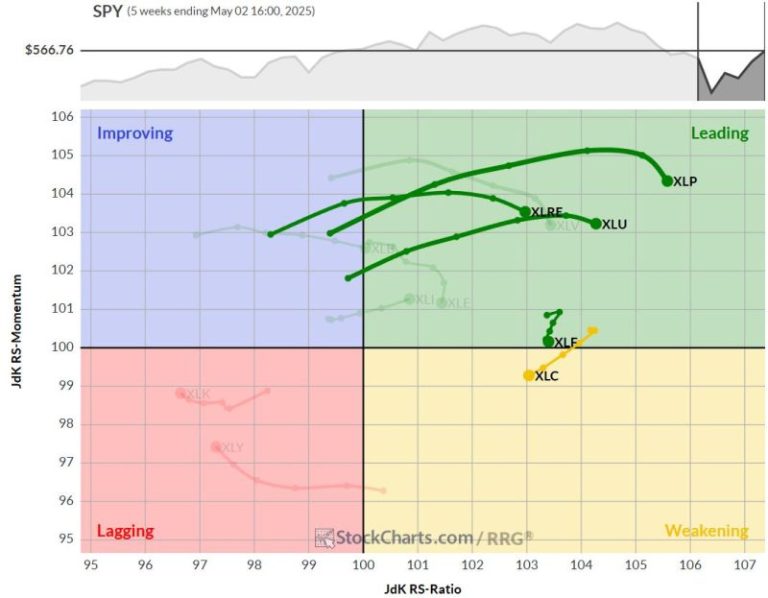
The composition of the top five sectors remains largely stable this week, with only slight adjustments in positioning. Consumer staples continue to lead the pack, followed by utilities, financials, real estate (moving up one spot), and communication services (dropping to fifth). This defensive lineup persists despite a rallying market, presenting an interesting dilemma for sector rotation strategies.

  1. (1) Consumer Staples – (XLP)
  2. (2) Utilities – (XLU)
  3. (3) Financials – (XLF)
  4. (5) Real-Estate – (XLRE)*
  5. (4) Communication Services – (XLC)*
  6. (6) Healthcare – (XLV)
  7. (7) Industrials – (XLI)
  8. (8) Materials – (XLB)
  9. (11) Technology – (XLK)*
  10. (10) Energy – (XLE)
  11. (9) Consumer Discretionary – (XLY)*

Weekly RRG

The weekly Relative Rotation Graph (RRG) paints a picture of potential change on the horizon.

While staples, utilities, real estate, and financials maintain their positions in the leading quadrant, they show signs of losing relative momentum over the past few weeks.

Financials, particularly, are teetering on the edge of rolling into the weakening quadrant.

Communication services have already shifted, now firmly in the weakening quadrant and traveling on a negative RRG heading. This movement explains its drop to the fifth position in our sector rankings.

Daily RRG

Switching to the daily RRG, we see a slightly different picture for our top sectors.

Staples, utilities, real estate, and financials are all positioned in the weakening quadrant, traveling on negative RRG headings.

This short-term view indicates that we must closely monitor these sectors to determine if they can regain momentum before potentially dropping out of the top five.

Interestingly, communication services is showing signs of life on the daily chart. Despite falling to the fifth position overall, its tail is now in the improving quadrant and moving toward leading.

The caveat? It’s a very short tail, close to the benchmark—essentially moving in line with the market. This makes communication services the sector most at risk of losing its top-five status in the near term.

Consumer Staples

Consumer staples is bumping up against overhead resistance between $82.50 and $83.

This hesitation in upward price movement is causing weakness in the RS line, which has started to dip.

Consequently, the RS momentum line is rolling over. However, the high RS ratio—indicating a strong relative trend—is keeping staples at the top of our list for now.

Utilities

Utilities has been flirting with a breakout since the start of 2025, pushing against overhead resistance around $80 about four times already.

When it breaks, we’ll likely see an acceleration towards the all-time high just above $82.50.

Like staples, the inability to break resistance is causing a stall in the RS line and a rollover in relative momentum.

Financials

After a strong rally off the $42 support level, previously resistance (the old technical adage holds true), financials is now facing a challenge.

The rally is approaching the former rising support level that marked the uptrend channel. This could cause some hesitation in both price and relative strength.

The RS line remains within its rising channel, but momentum has waned, causing the green RS momentum line to roll over.

Real-Estate

Real estate moved up one position to fourth and is still emerging from a long relative downtrend that began in April 2022.

The RS ratio line has picked up the relative strength rally that started in early 2025 but is now stalling.

This has resulted in the green RS momentum line rolling over. On the price chart, real estate is mid-range with room to move higher.

Communication Services

Communication services have dropped to the fifth position, but the price chart has an interesting development.

Last week, the price broke back above the old neckline of a small head-and-shoulders pattern. The fact that we’re now rallying above this neckline could indicate a failed head-and-shoulders pattern—usually a very strong bullish sign.

However, recent weakness in relative strength has pushed the sector deeper into the weakening quadrant on the RRG.

This sector must pick up rapidly in the coming weeks to maintain its position in the top five.

Portfolio Performance

The defensive positioning of our top five sectors is leading to underperformance as the broader market rallies.

Currently, we remain at approximately a 3% underperformance compared to SPY just like last week.

However, from the perspective of sector rotation, we must still consider this rally in the S&P 500 to be temporary.

The underlying message continues to emphasize defense.

It’s important to remember that there is always a lagging element in RRGs and this strategy.

If the market has truly turned, we will see that shift reflected in our sectors, and at some point, we will start to make up the difference.

These performance gaps can change very rapidly in favor of the RRG portfolio when the market comes under pressure and our defensive sectors start to lead again.

#StayAlert and have a great week — Julius


In this video, Dave reveals four key charts he’s watching to determine whether the S&P 500 and Nasdaq 100 will be able to power through their 200-day moving averages en route to higher highs. Using the recently updated StockCharts Market Summary page, he covers moving average breadth measures, his proprietary Market Trend Model, offense vs. defense ratios, and the Bullish Percent Indexes.

This video originally premiered on May 5, 2025. Watch on StockCharts’ dedicated David Keller page!

Previously recorded videos from Dave are available at this link.